
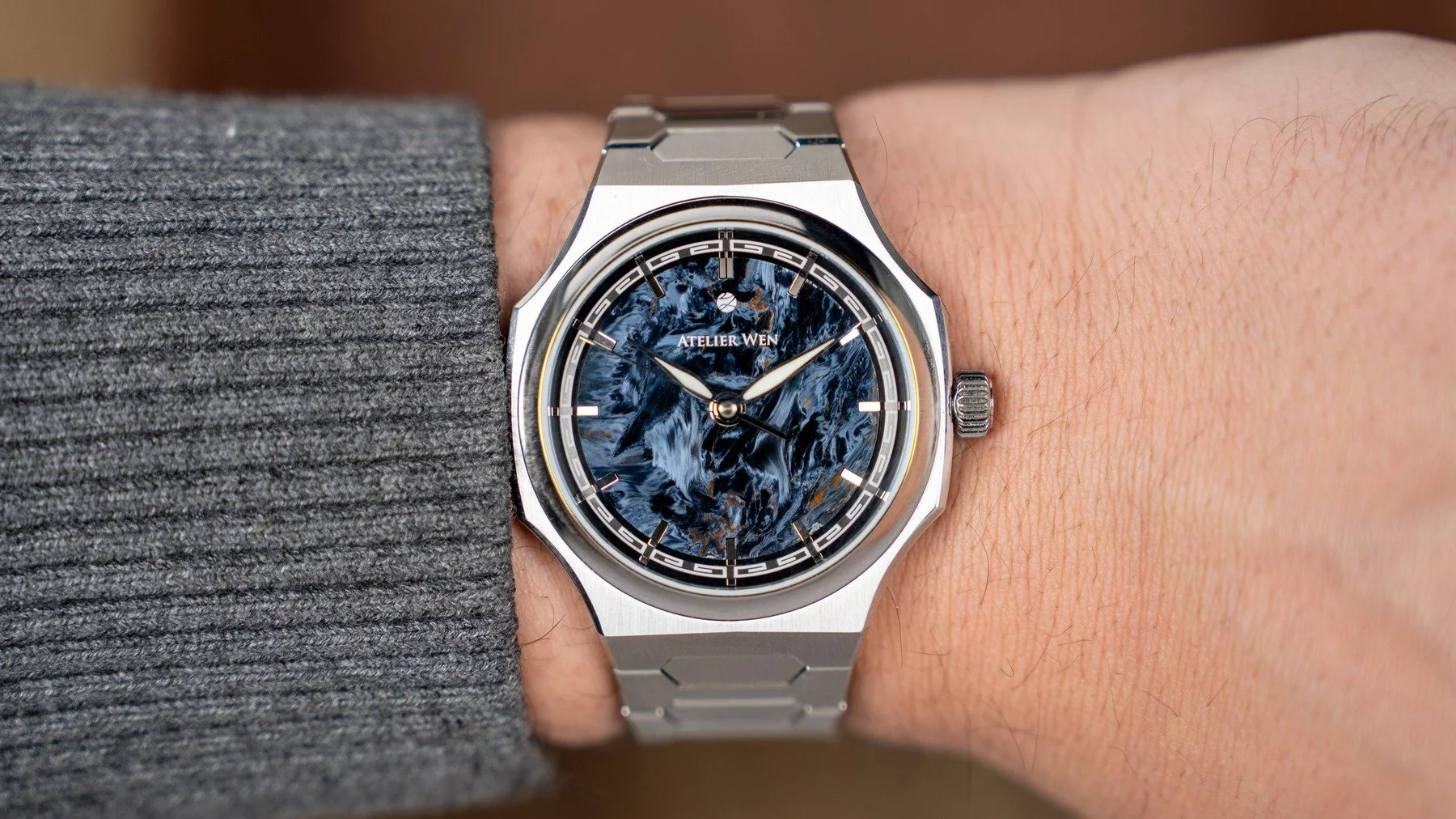
Atelier Wen is the brand that made me stop saying Chinese watch as if it were a warning. It was started by two Frenchmen who fell for Chinese culture, and it makes its watches with the best artisans it can find in China. In eight years it has gone from a $700 porcelain-dial watch on Kickstarter to a $30,000 tantalum watch with a Girard-Perregaux movement inside. I have had six of them on the wrist, more than any other brand in this series of explainers, and I have come away impressed every time.
So here is everything you need to know about Atelier Wen. I will cover who is behind it, where the watches are actually made, the five lines worth your money, what they cost in 2026, and which one I would buy. Where I have reviewed a watch, and that is most of them, I will link to the review so you can see it on the wrist.
Who Is Behind Atelier Wen?
Atelier Wen was founded in 2018 by Robin Tallendier and Wilfried Buiron, two Frenchmen who met as students in Beijing in 2016. Robin had worked for the French watchmaking chamber in Shanghai and at Christie's in London and is the creative side of the company. Wilfried was born in Hong Kong, studied at Peking and Tsinghua, and has run design and manufacturing from Beijing since the beginning. The name is a French word and a Chinese one put together: atelier is a workshop, and wén is culture. The company is registered in Hong Kong.
The first watch was the Porcelain Odyssey, a pair of dress watches called Ji and Hao with real porcelain dials and a Chinese movement. It launched on Kickstarter in October 2018 at around $700. They funded in under 30 minutes and sold out, and then the brand went quiet for two years while it worked out what to do next. The answer was the Perception, an integrated-bracelet steel sports watch with a hand-guilloché dial, which opened for preorders in April 2022 and sold its first batch in 16 hours. That watch made the brand. Since then Atelier Wen has moved up the ladder a rung a year. There was a tantalum Perception in 2024, the Ancestra with an enamel dial and a French movement in 2025, the $29,800 Inflection later that year, and a $44,100 collaboration with Massena LAB in 2026. I first wrote about the founders when they launched a web series that took viewers inside their workshops. The thing that has stayed true is that they show you where everything comes from.
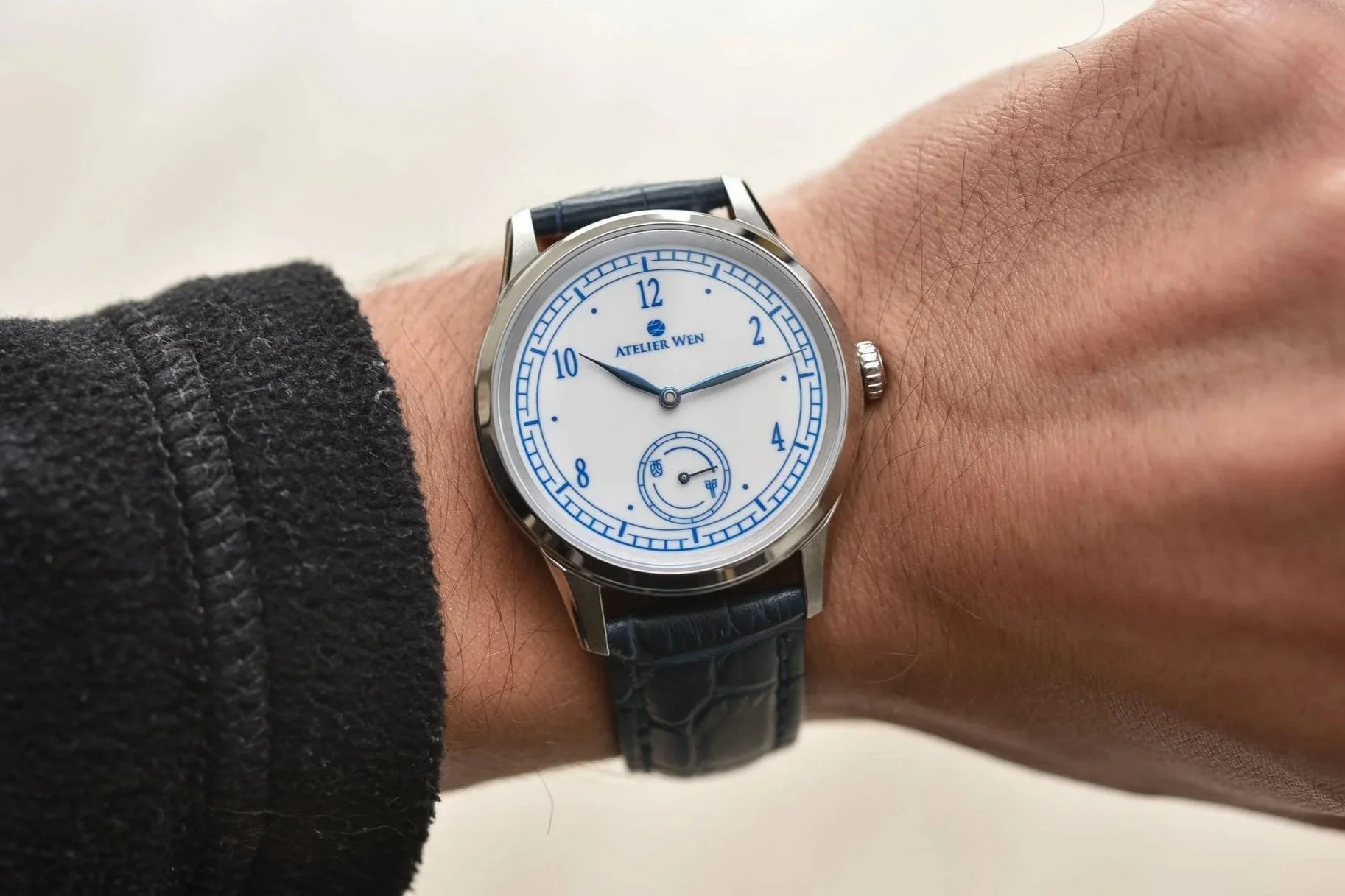
Photo: Monochrome Watches
Where Are Atelier Wen Watches Made?
In China, by name. That is the whole point of the brand and it is the opposite of how most watch companies talk about their suppliers. The guilloché dials on every Perception are hand-turned on rose engines in the workshop of Cheng Yucai in Xinmi, Henan, who is the only master guilloché craftsman in mainland China. Each dial is a fish-scale pattern cut by a diamond tool on a hand-cranked machine, it takes about eight hours, and a single slip means starting over. The enamel dials on the Ancestra and the Inflection come from the Beijing workshop of Kong Lingjun, the most respected enamel atelier in the country. A dial there is fired at over 800 degrees Celsius up to six times, and about half of them do not survive. The cases and bracelets are 904L steel, grade 5 titanium or 99.9 percent tantalum, and the finishing on all three is what first convinced me the brand was serious.
The movements are where the story has changed. The early Perceptions ran a Chinese automatic, the Dandong SL1588A, also sold as Peacock. It is an extra-thin 3.4mm caliber that Atelier Wen had regulated in five positions to plus or minus ten seconds a day. I reviewed two of them and never had a problem. In 2025 the brand went to France for the Ancestra, with a Pequignet EPM03 from Morteau. In 2026 the Perception V3 got the same movement, with its bridges reshaped and filled with blue aventurine lacquer. The Inflection runs a customized Girard-Perregaux GP03300. Some people see that as a retreat from the Chinese idea. I see two French founders using French and Swiss movements for a brand that was always meant to be Sino-French. The dials and cases, the parts you actually look at, are still made in China. The warranty is five years and the brand sells direct from Hong Kong with free shipping.
The One That Made the Brand: Perception
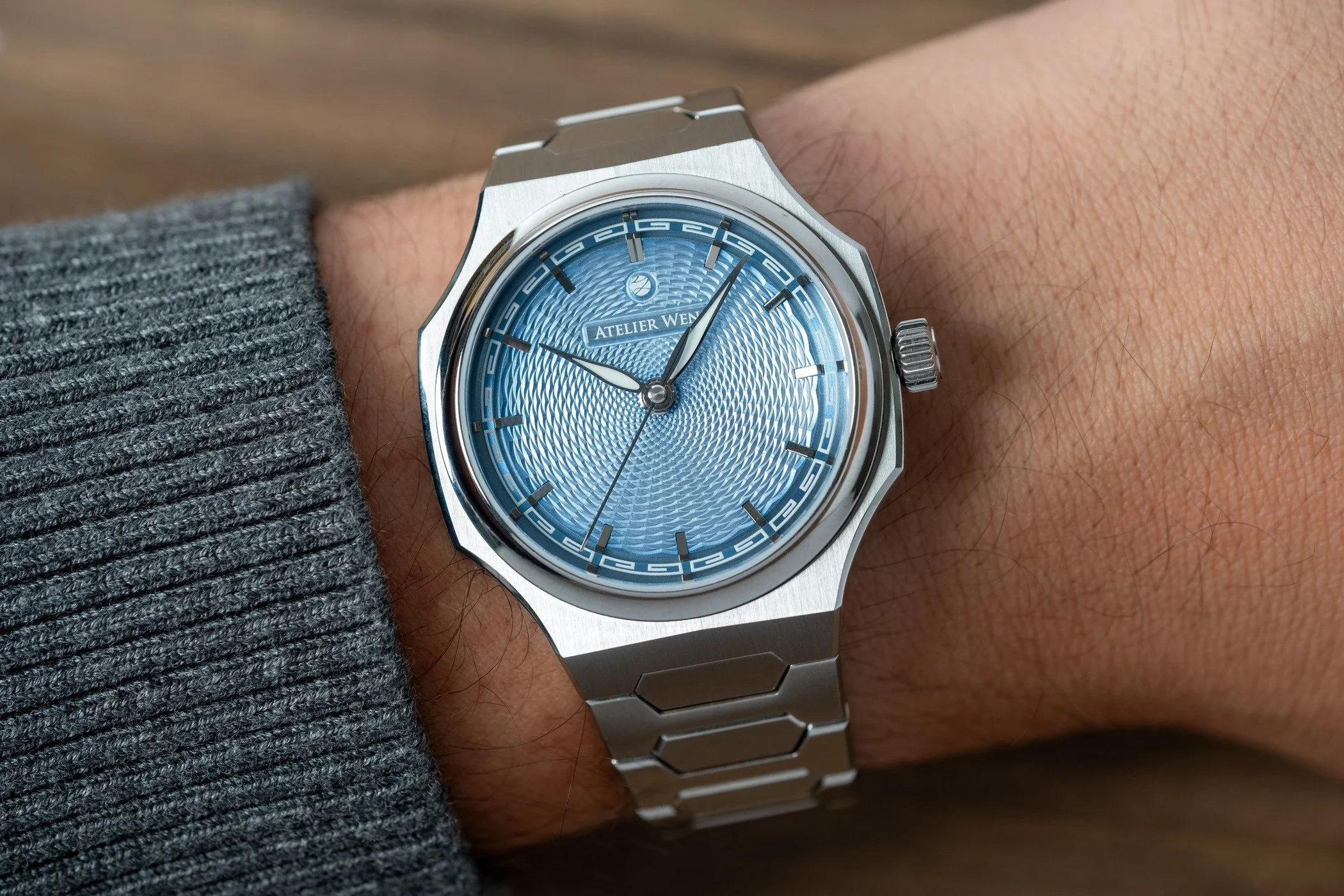
Case Size: 40mm, Thickness: 9.4mm, Lug-to-Lug: 47mm, Material: 904L Stainless Steel or Grade 5 Titanium, Movement: Dandong SL1588A Automatic, Regulated in 5 Positions, Power Reserve: 41 Hours, Water Resistance: 100m, Crown: Screw-Down, Dial: Hand-Guilloché by Cheng Yucai, Bracelet: Integrated with On-the-Fly Micro-Adjust, Price: $3,288 USD for the second-generation steel watch, now replaced by the V3
The Perception is the watch that put Atelier Wen on the map, and the one I would still point a first-time buyer to on the secondary market. It is an integrated-bracelet sports watch with a case that has wings on either side, which will remind you of a Nautilus until you see it in person. Then you realize the wings are softer, the case is squarer and the profile from the side looks like a pagoda roof. It is 40mm by 47mm lug-to-lug and 9.4mm thick. In my review of the steel Perception I wrote that it wore better on my 6.75-inch wrist than a Royal Oak does. The bracelet drops straight down from the case and the whole thing hugs the wrist instead of spanning it.
The bracelet is a single-piece H-link held together with hexagonal pieces, chamfered and polished on every edge including the inside of the links, and it tapers from 22mm to 18mm. Pressing the logo on the clasp opens a micro-adjust you can use with the watch on. The dial is the reason to buy it. It is hand-guilloché in a fish-scale pattern, in light blue or salmon on the steel watch. I have not seen anything like it on a watch at this price from anyone. The caseback has a Chinese lion engraved on it, with the display window where the mouth would be. That is a good decision, because the movement is well finished but not pretty enough for a full window. The Perception was the editor's pick in our guide to the best microbrand watches for exactly these reasons, and it is on our list of Chinese watch brands worth knowing.
The second-generation steel Perception was $3,288 USD. It has been replaced by the V3 below, so the way to buy one now is secondhand, where they hold their value well.
The Yearly Vintage: Perception Millésime
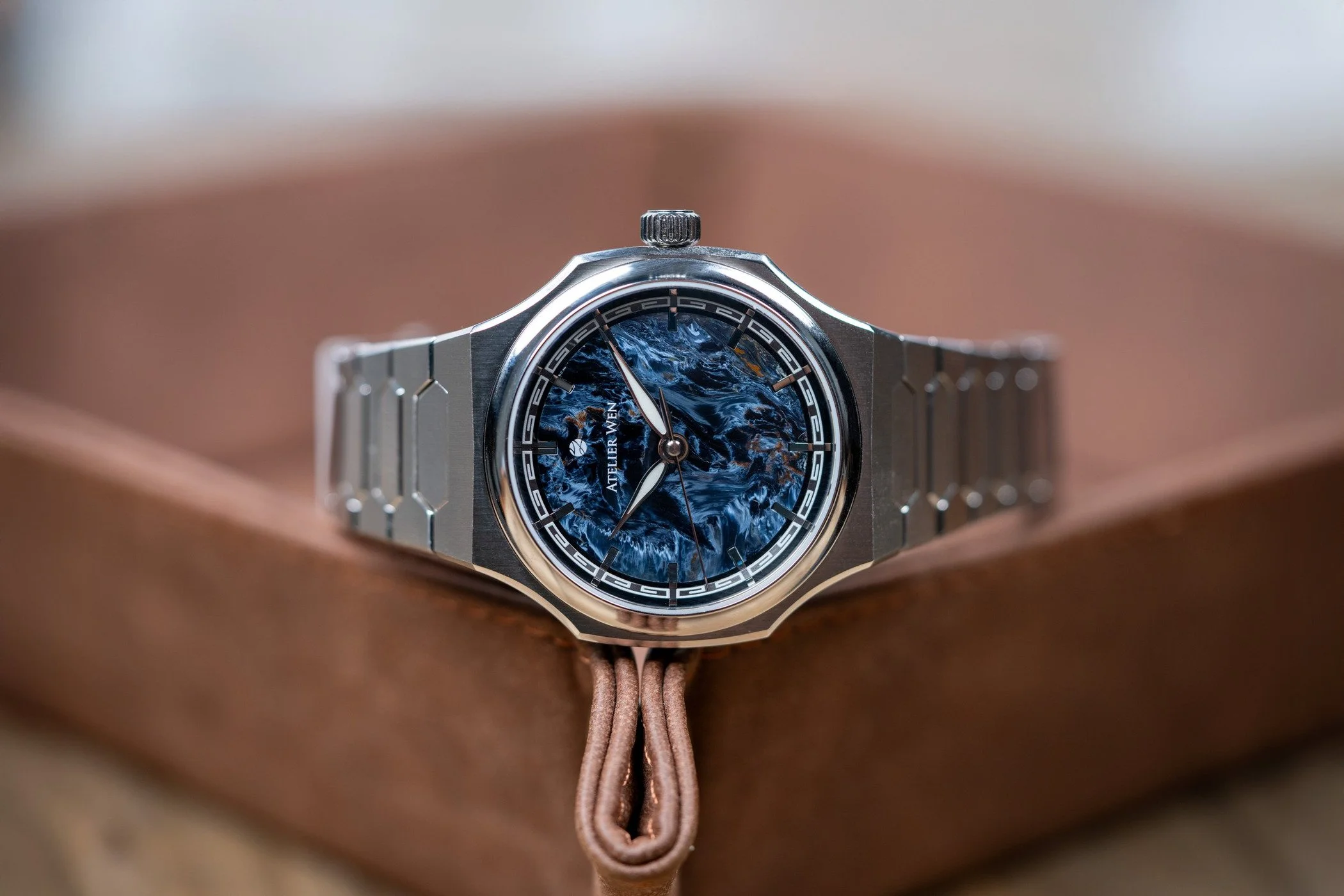
Millésime 2024 Mù: Grade 5 Titanium, Purple Guilloché Dial, $3,588 USD. Millésime 2025 Xuán: 904L Steel, Natural Pietersite Dial, $3,600 USD. Both: Case Size: 40mm, Thickness: 9.4mm, Lug-to-Lug: 47mm, Movement: Dandong SL1588A Automatic, Water Resistance: 100m, Time-Limited Order Window
The Millésime is Atelier Wen's answer to the limited edition, and it is a better answer than most. Once a year the brand takes the Perception, pushes it in one direction, opens an order window for a couple of weeks, and then never makes that version again. There is no fixed number, so nobody is refreshing a page at midnight, and there is no second run, so the watch stays what it was. The first was the Mù in October 2024, the first titanium Perception that was not a collaboration, in grade 5 with a deep purple guilloché dial. I reviewed the Mù and could not decide between it and the steel watch, which is the highest compliment I can pay a limited edition. Three buyers were picked at random to get their purple dial in a tantalum prototype case instead, which tells you something about how this brand thinks.
The second was the Xuán in January 2026, the brand's first stone dial and the best Perception I have had on the wrist. The stone is natural pietersite, which reads as deep blue until you look closely and find lighter veins and flecks of gold moving through it. No two dials are alike. Pietersite is brittle, each of the twelve index cutouts is wire-cut by hand, and a lot of slabs were rejected because the pattern was wrong. The case is 904L steel with the same 9.4mm thickness and the same bracelet, and the first 225 were numbered and sealed. In my review of the Xuán I called it the most confident thing the brand has done at its core price, and I stand by that. The window closed in February 2026, so, like the Mù, it is a secondhand watch now.
The Mù was $3,588 USD and the Xuán was $3,600 USD. The next Millésime should arrive in early 2027, and if the pattern holds it will be the best value in the lineup for two weeks.
The Current One: Perception V3
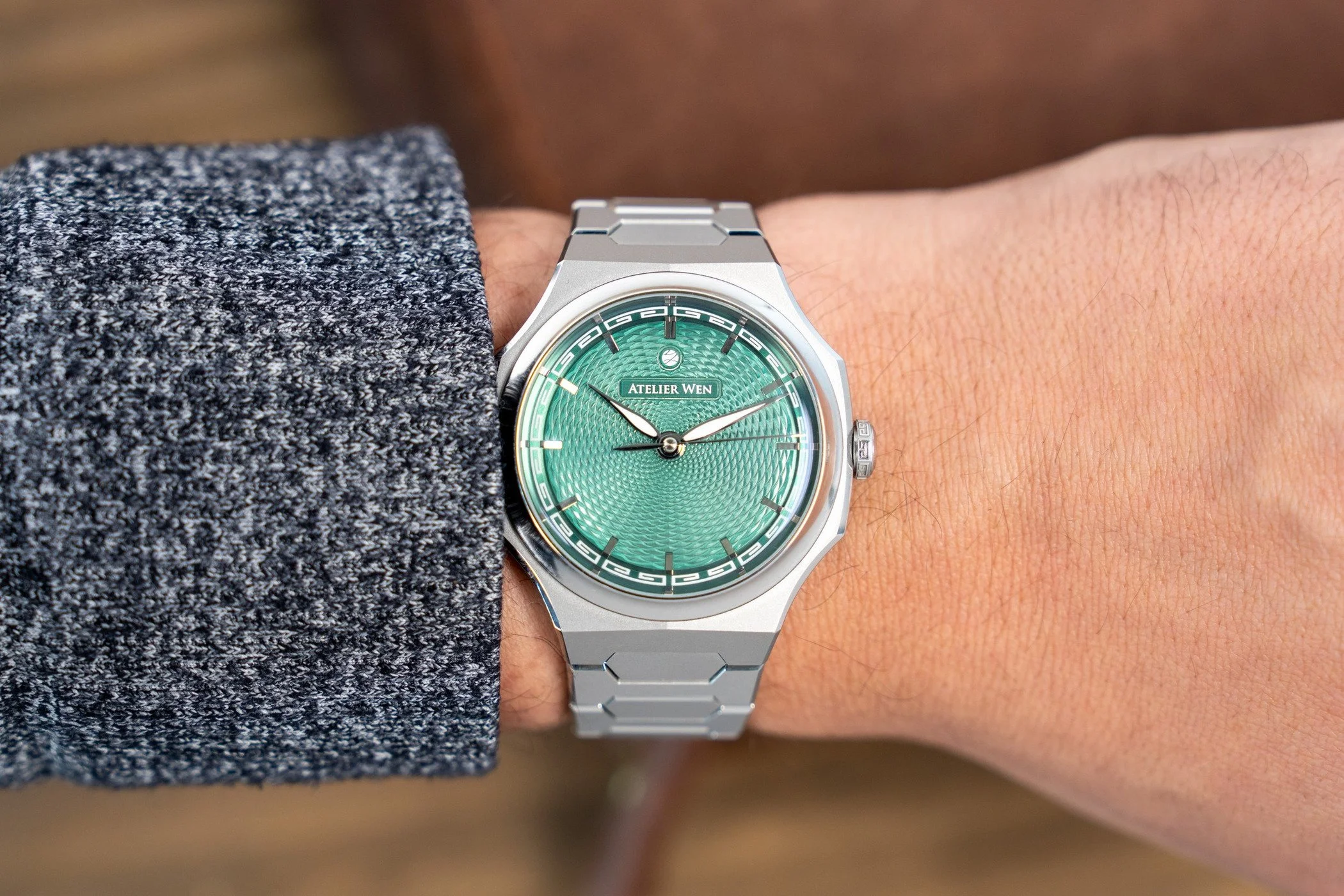
Case Size: 40mm, Thickness: 10.4mm, Lug-to-Lug: 47mm, Material: 904L Stainless Steel, Movement: Pequignet EPM03 Automatic, Customized, Power Reserve: 65 Hours, Water Resistance: 100m, Crystal: Double-Domed Sapphire, Caseback: Full Exhibition, Dial: Hand-Guilloché by Cheng Yucai, Dials: Piāo Ice Blue, Xiá Salmon, Yún Bamboo Green, Price: $4,850 USD
The Perception V3 is the current core watch and the one you can actually order today. It launched in May 2026 and it looks like the watch it replaces until you turn it over. The Chinese movement is gone, and in its place is a customized Pequignet EPM03, a French manufacture automatic with 65 hours of reserve and hacking seconds. Its bridges are reshaped into the curves of wind in traditional Chinese art and filled with blue aventurine lacquer, so they shimmer like a night sky. That earned the watch a full exhibition back for the first time, and it cost a millimeter of thickness, from 9.4mm to 10.4mm. The crown got smaller and picked up knurling that matches the minute track.
The three dials are the ice-blue Piāo, the salmon Xiá and the new bamboo-green Yún. The Yún is the one I would get, because on that version the brushing is replaced with a micro-blasted finish on the case and bracelet, with the polished bevels left sharp. The result looks carved rather than assembled. I spent time with it for my review of the V3 Yún and found the extra thickness a fair trade on the wrist. The case curves and the first links follow it. The price went up with the movement, from $3,288 USD to $4,850 USD, and the upgrades track with it. The days of calling it a bargain are over. What it is now is one of the only integrated watches at the price with a hand-cut dial from a named workshop and an independent manufacture movement. It sits in the gap between a Christopher Ward Twelve and a Laureato.
The Perception V3 costs $4,850 USD in all three dials. Deliveries started in September 2026 and all three dials are available to order as I write this.
The Dress Watch: Ancestra Jiāo
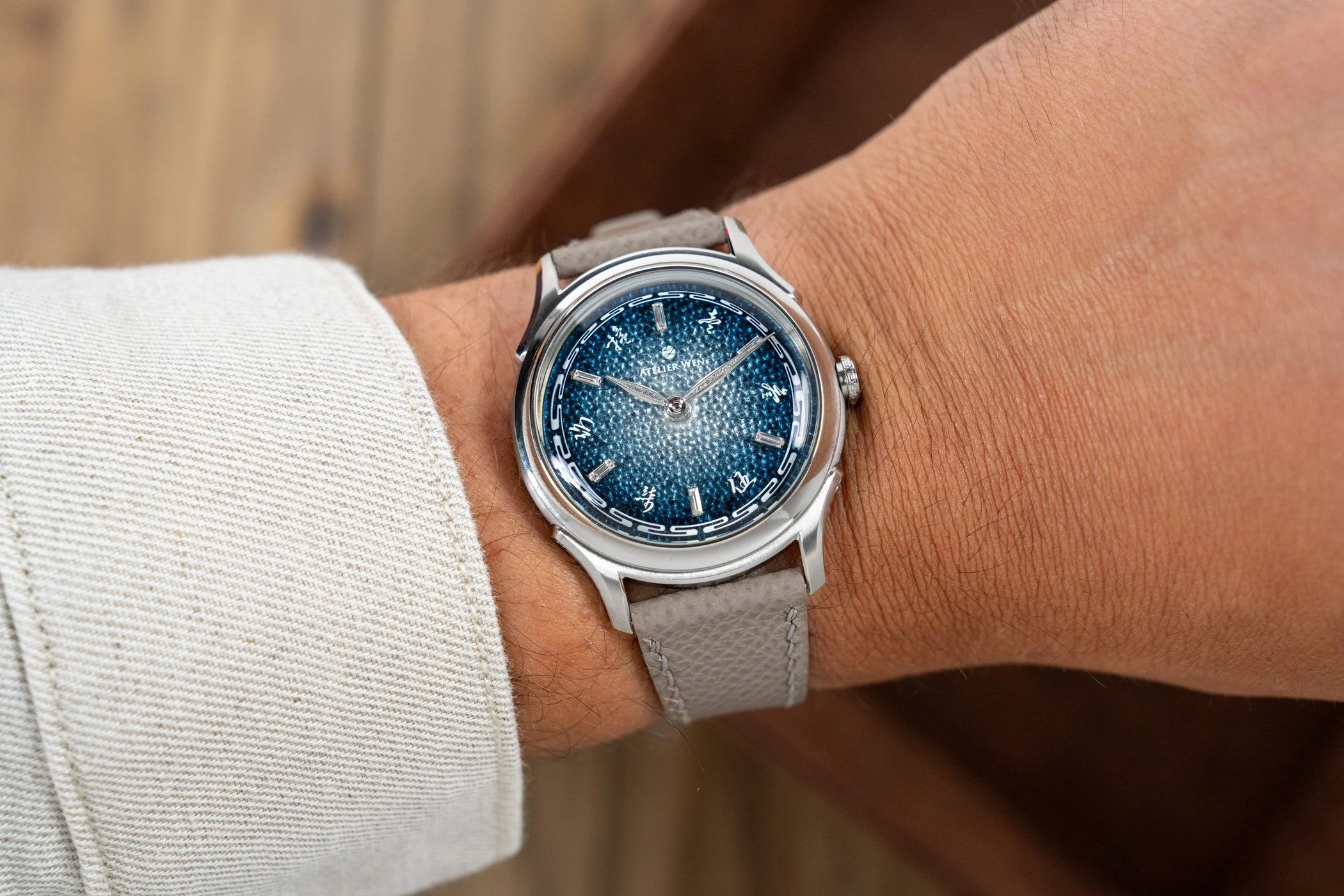
Case Size: 38mm, Thickness: Just Over 11mm, Lug-to-Lug: 46mm, Material: 904L Stainless Steel with Detachable Lugs, Movement: Pequignet EPM03 Automatic, Customized, Power Reserve: 65 Hours, Water Resistance: 100m, Crystal: Double-Domed Sapphire, Dial: Hand-Hammered 925 Silver with Grand Feu Enamel by Kong Lingjun, Strap: Epsom Leather 20mm to 16mm, Price: $5,850 USD
The Ancestra is the dress watch, and it is where Atelier Wen started working with enamel. The debut model is the Jiāo, named for a sea dragon in Chinese mythology. Its 38mm case takes its curves from the jade dragons of the Hongshan culture, 5,000-year-old carvings that are among the earliest dragons in Chinese art. The lugs are machined separately and attached with engraved screws, which lets the brand finish the transitions between brushed and polished surfaces sharper than a one-piece case allows. The leaf hands are built in three dimensions, with a frosted center and mirror-polished concave bevels.
The dial is a 925 silver plate hammered by hand and then coated in grand feu enamel, fired up to six times. The gradient runs from pale silver at the center to deep cobalt at the edge, and the texture underneath catches light in a way a flat enamel dial does not. You can have the odd hours in hand-drawn Chinese calligraphy by Elaine Wong or in Arabic numerals in the style of bamboo painting. Either way there are baguette lab-grown diamonds at the even positions. The Pequignet movement inside has lines from Questions to Heaven, a 2,300-year-old poem, etched into its three-quarter bridge. When I had it on for my review of the Ancestra it wore compact but present at 46mm lug-to-lug. I called the dial the best enamel I had seen under $6,000. The catch is time. It sold in a one-week window in July 2025 for delivery in 2026, and the brand still lists it at $5,850 USD, so check the current window before you fall for it.
The Ancestra Jiāo costs $5,850 USD with either set of numerals.
The Big Bet: Inflection
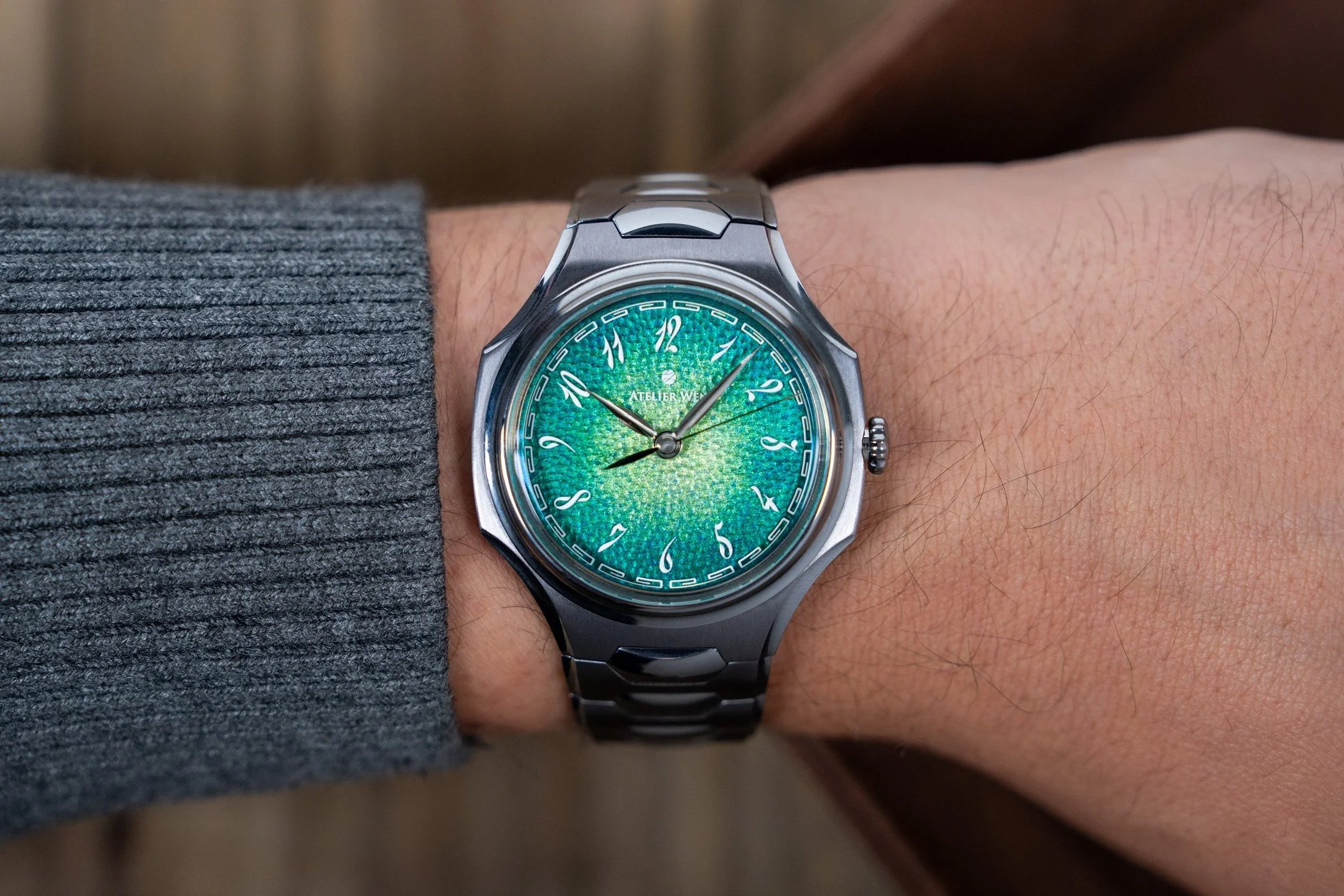
Case Size: 40mm, Thickness: 10.6mm, Lug-to-Lug: 45mm, Material: 99.9 Percent Tantalum Case and Bracelet, Movement: Girard-Perregaux GP03300 Automatic, Customized, Dial: Grand Feu Enamel by Kong Lingjun in Black, Blue or Green Yōu, Clasp: Four-Position On-the-Fly Micro-Adjust, Price: $29,800 USD on the Bracelet, $19,800 USD on FKM Strap, Massena LAB Shuò $44,100 USD
The Inflection is the watch that moved Atelier Wen into a different league. It did it in tantalum, a metal so dense and so hard on tooling that most brands will not touch it. The brand had already made a 25-piece tantalum Perception called the Hóng in 2024, priced at $10,000 USD, which sold out at once and proved the point. The Inflection launched in November 2025 as a full tantalum case and bracelet with a four-position micro-adjust clasp. The grand feu enamel dial comes from Kong Lingjun's workshop in black, blue or a green called Yōu that fades from mint at the center to viridian at the edge. Inside is a Girard-Perregaux GP03300 with its bridges cut into flowing wind patterns and finished in ruthenium, polished bevels and rose gold. The design is the Perception with its angles softened into curves, a play on yin and yang in brushed and polished surfaces.
I first saw it under embargo on Robin's wrist and then wore the green one for several days for my review of the Inflection. I measured it at 10.6mm with calipers. At 40mm by 45mm it is easier to wear than the weight suggests, because the case and the bracelet curve together. At $29,800 USD it is a statement, and I think it earns it. The brand followed it in September 2026 with the Inflection Shuò, a 50-piece collaboration with Massena LAB. It has a solid 18k gold dial decorated by hand in tremblage and a California layout that mixes Arabic numerals with hand-calligraphed Chinese ones. Forty have rose gold rings and ten white gold, the white gold went to friends of the brand, and the price is $44,100 USD on the tantalum bracelet.
The Inflection costs $29,800 USD on the tantalum bracelet and $19,800 USD on an FKM sailcloth strap, and the standard editions are sold out as I write this. The Inflection Shuò costs $44,100 USD.
Are Atelier Wen Watches Good?
Yes, and I say that having worn six of them rather than read about them. The dials are the best in their price range, whether that is the hand-cut guilloché at $4,850 USD or the hammered enamel at $5,850 USD. They come from named workshops you can watch on video. The case and bracelet finishing on the Perception is at the level of Christopher Ward and Oris. On the tantalum watches it is at a level those brands do not attempt. The integrated bracelet is one of the few that is not a Nautilus or Royal Oak copy, and the on-the-fly clasp is a real feature. The sizes are right, 38mm and 40mm, and every watch wears smaller than its number. And the brand has never shipped a watch that felt like a step sideways.
With that being said, there are a few things to know going in. The way Atelier Wen sells is the main one. Most of the lineup is sold in order windows and then gone, so the watch you read about is often the watch you cannot buy. Deliveries can be a year out. The move from Chinese to French movements took the price of the core watch up by half. If you want the Chinese-movement Perception at its old price, the secondhand market is where it lives. The Dandong movement in the earlier watches is a fine caliber but your local watchmaker will not have parts for it. And the whole proposition rests on two founders and a handful of artisans, which is what makes the watches special and what makes the brand small.
How Much Do Atelier Wen Watches Cost?
Atelier Wen watches cost $4,850 USD to $44,100 USD new in 2026, with the earlier Perceptions available secondhand for less. Here is how the lineup breaks down at the brand's US prices:
Perception, steel, second generation (discontinued): $3,288 USD
Perception Millésime 2024 Mù, titanium (window closed): $3,588 USD
Perception Millésime 2025 Xuán, pietersite dial (window closed): $3,600 USD
Perception V3: $4,850 USD
Ancestra Jiāo: $5,850 USD
Perception Hóng, tantalum, 25 pieces (sold out): $10,000 USD
Inflection on FKM strap: $19,800 USD
Inflection on tantalum bracelet: $29,800 USD
Atelier Wen x Massena LAB Inflection Shuò: $44,100 USD
Where should you buy one? Direct from atelierwen.com, which prices in US dollars for American buyers, ships free and carries a five-year warranty, is the answer for anything in a current window. The brand also has a short list of authorized retailers and shows up at the Windup fairs, which is the best place to see the dials in person. For the discontinued Perceptions and the Millésimes, the secondary market is the only route. Because every version was made once and never again, they tend to sell for close to what they cost new.
All-in-all, Atelier Wen is the brand that has done the most to change what people expect from a watch made in China. It has done it by naming the people who make the parts and letting the work speak. Buy the Perception V3 if you want the watch that made the brand in its most complete form. Watch for the next Millésime if you want the best value, and buy the Ancestra if you want the dial I still think about.