
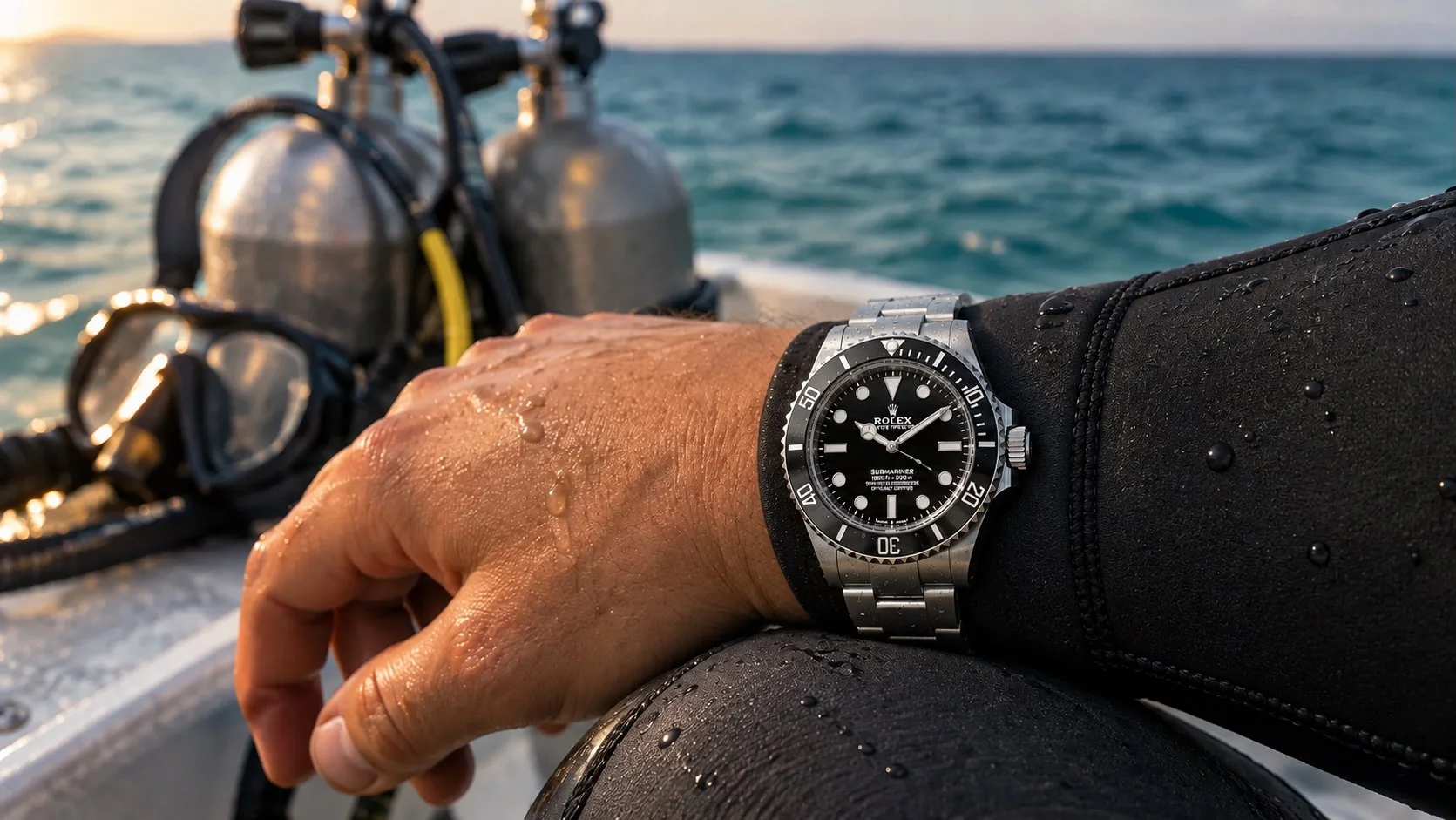
The last time I was on a dive boat, I was wearing the watch I wear 95% of the time: my Rolex Submariner ref. 14060M. I have had it since new, 25 years now, and it virtually never leaves my wrist.
The boat was a mix of younger, less experienced divers and old hands. Most everybody wore a dive computer to track depth, bottom time, decompression stops, and the other data crucial to safe SCUBA diving. The divemaster and boat owner was wearing an Apple Watch Ultra, and I was the only schmuck wearing an actual dive watch.
“Are you actually gonna dive with that thing?” someone asked me. It was far from the first time I have gotten this question on a dive boat. “Aren’t you worried about it?”
These are fair queries. After all, it is 2026, not 1966, and a Submariner is now firmly a luxury item, and priced accordingly. (The inflation-adjusted price for a ref. 5513 in the mid-1960s was something like $1,800, certainly not an inexpensive object, but nowhere near the $10,050 sticker price of the modern equivalent.) In addition to being pricey to replace and personally important to me, the Submariner does not do nearly as much as the dive computer does, and it does not do it nearly as elegantly. Still, I have come to love the feel of its analog timekeeping, forcing me to actually use the bezel and to glance down at my wrist in addition to my depth gauge. I could make the classic argument that the watch is a backup in case the computer fails, but I am ready to acknowledge that while technically true, this is mostly B.S.
The truth is, I just enjoy using the Submariner the way that it was intended to be used. And since it is always on my wrist anyway, it feels natural to have it accompany me on any and all adventures in which I participate. If you, like me, plan on actually diving with your dive watch, or watches, then there are a few things you should keep in mind while you do so.
What Does “Professional” Actually Mean on a Dive Watch, and Is ISO 6425 Something Anyone Should Care About?
ISO 6425 is an international standard that established the minimum requirements for a watch to be considered a true “diver’s watch.” Such standards include 200m of water resistance; a device, typically a bezel, for measuring at least 60 minutes of elapsed time; some kind of indication that the watch is running; ISO 764 requirements for magnetic resistance; ISO 1413 requirements for shock resistance; temperature resistance; saltwater resistance; strap and bracelet security; and additional requirements for watches intended for saturation diving. Importantly, brands do not have to send watches for independent certification, and can declare conformity themselves. (Watches are generally also pressure-tested to 125% of their stated depth rating.)
A “professional” diver’s watch, which is typically part of a model name, generally indicates a watch that conforms to these standards. As there are myriad timepieces that borrow dive-watch aesthetics but do not offer many of the aforementioned features, it is important to be able to differentiate between an ISO-compliant dive watch and a dive-style watch, if for no other reason than that many of the latter do not have adequate water resistance for diving.
How Much Water Resistance Do You Really Need, and When Do 200m, 300m and a Helium Escape Valve Stop Meaning Anything?
While ISO 6425 defines a “dive watch” as one with at least 200m of water resistance, the reality is that when watches such as the Submariner debuted, they did so with 100m of water resistance, which was totally fine. Why? Because recreational SCUBA diving rarely ventures below depths of 40m. If a watch is reasonably well made, with secure gaskets, a screw-down crown, and a screw-down caseback, chances are good that it will handle your PADI-certification dives.
However. The likelihood is strong that if you are buying a new dive watch, and it is actually a dive watch and not a dive-style watch that, say, has a rotating bezel but is otherwise a quartz-powered piece of Chinese-made junk that you found for $40 at Costco, it is going to have at least 200m of water resistance right out of the gate. And if you are shelling out big-boy money for something like a Submariner or an Omega Seamaster Diver 300M? Well, you are getting 300m of water resistance, so you really do not have anything to worry about. (If you are SCUBA diving at 300m, mazel tov, because you are a fish, and you should spend your life doing fish things.)
And what is all this, you ask, about helium escape valves? If you are a professional saturation diver, you spend prolonged periods living at depth in pressurized environments that contain helium gas. The tiny helium molecules penetrate the watch, and during decompression, a drop in outer pressure can cause them to blow the crystal right off the watch head. For this, the HEV was developed: it generally consists of a small one-way valve that allows the watch to off-gas helium. Why do many professional diving watches have this incredibly niche feature when there are so few saturation divers in the world? Because grown-ass men like to cosplay, as soldiers, as divers, as race-car drivers. That is why. HEVs sell watches to cosplayers.
How Do You Actually Use the Watch’s Bezel During a Dive, and Why Does a 120-Click Unidirectional Bezel Beat a 60-Click?
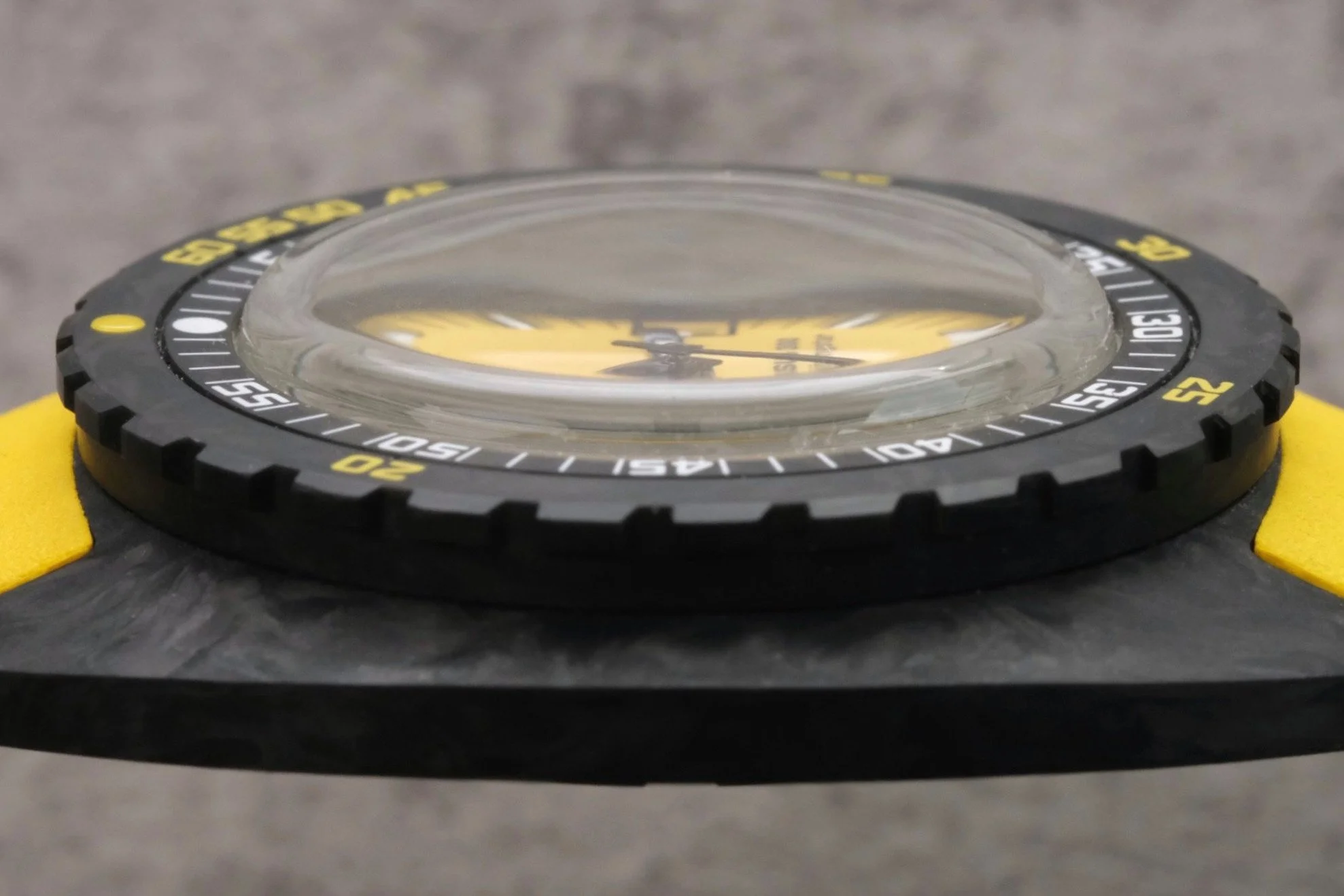
For those of you wondering what a rotating dive bezel, also called a “count-up” bezel, is actually for, the idea is this: the aluminum or ceramic insert on the bezel features numbers 1 to 60, sometimes with resolution down to the individual minute for every minute, and sometimes up to only 15 or 20 minutes. When you enter the water, or hit the ocean floor, or ascend to make a decompression stop, you turn the bezel such that the “pip” at 12 o’clock lines up with the current minute. This way, you can see at a glance how many minutes have elapsed.
Before dive computers, this was the only way to accurately track elapsed time underwater, and thus a reliable dive watch was a crucial piece of kit. (Hence why so many were issued to frogmen and divers in various militaries around the world between the 1930s and early 2000s.) However, early dive watches featured bidirectional “friction” bezels, which were dangerous: a knock could easily move them, which would ruin one’s elapsed-time calculation. The advent of the unidirectional bezel, which can only turn counterclockwise, made this calculation much safer for computing bottom time, as the diver can over-calculate, but not under-calculate it.
The hullabaloo regarding “60-click” or “120-click” resolution is as follows: depending upon the watch, a dive bezel will generally click once per minute of elapsed time, or twice. While 60 “clicks” is theoretically adequate, 120 gives one double the resolution, and thus makes for more precise calculation of elapsed time. (Most modern dive watches feature 120-click resolution. GMT and other watches, which use bezels that calculate time differentials, elapsed hours, and so on, often feature much lower resolutions, which is more useful for those systems.)
Can You Dive With a Non-Dive Watch if It Has, Say, 50m of Water Resistance?
On a tour of Omega’s production facilities, the guide reminded us that a modern Speedmaster is depth-rated to 50m, and so long as one does not actuate its chronograph pushers underwater, they should not be afraid to get it wet, or even swim with it.
While most of us would probably prefer not to tempt Poseidon with ruining a $9,000 chronograph, the watchmaker had a point: a non-dive watch on a bracelet or fabric strap rated to 50m, or even 30m, is perfectly OK to swim with. (Thierry Stern, President of Patek Philippe, once made a similar point to me and several other journalists about the Cubitus, namely that there is no reason one should be afraid to swim with one.)
However, diving is another story, and diving with a non-dive watch is yet another story. SCUBA, unlike swimming, involves prolonged stays at depth, which puts lots of pressure (literal and figurative) on equipment, especially if it is done in saltwater. And while modern chronographs have gaskets in their pushers, they are not meant to be used underwater, which can allow water to enter the case. Dress watches, as you can imagine, are not designed for diving, but rather for looking good when paired with a tuxedo. Field watches, which often have high water-resistance ratings and screw-down crowns and casebacks, might be used as dive watches in a pinch, but seeing as they generally do not have rotating bezels, they provide little utility beyond telling the time.
Something like a G-SHOCK is the exception to the rule. These things, with their buttons and rubber and batteries and all sorts of stuff, are absolute tanks. They can be, and often are, used by military divers and commandos, though it is really only the Frogman series that is meant to be actuated underwater. (Others can be worn underwater but are not necessarily meant to have their buttons pushed.)
What Matters About Lume Underwater, and Is a Lumed Bezel a Gimmick or a Real Advantage?
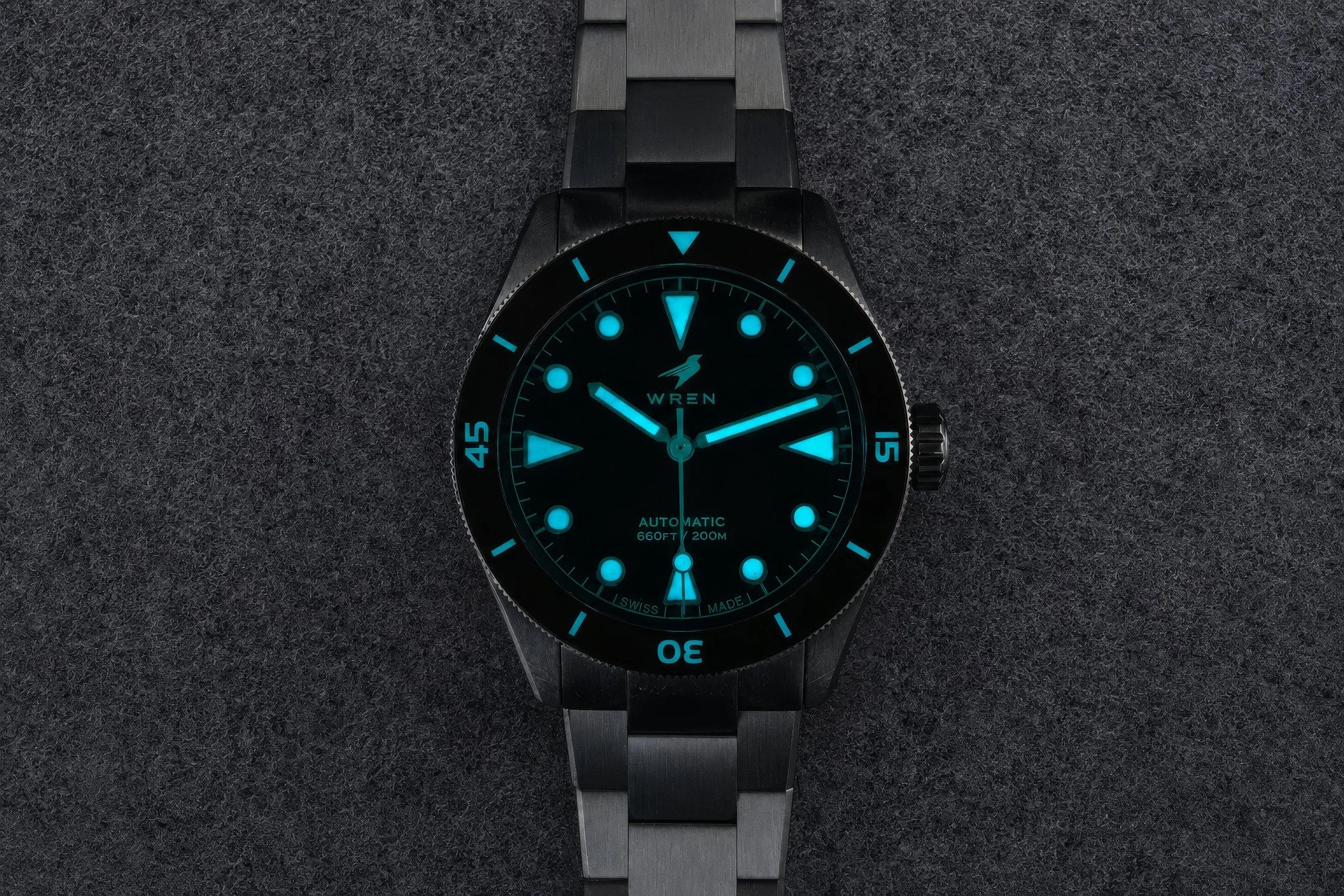
A dive watch that is not sufficiently luminous is effectively useless underwater. As the depth increases, less and less visible light makes it to the bottom, distorting one’s perception of color and making it difficult to see. (It can be difficult to see anyway, given silt in the water.) What you need is a watch whose indices are clearly visible via some kind of luminous agent, generally Super-LumiNova today, though it could be tritium tubes or another mechanism or substance, plus a luminous pip at 12 o’clock on your dive bezel to discern elapsed time. In fact, the 2018 revision to ISO 6425 includes a test conducted a full 180 minutes after a watch’s initial exposure to light.
What About Thickness, Lug-to-Lug and the Rest on a Dive Watch?
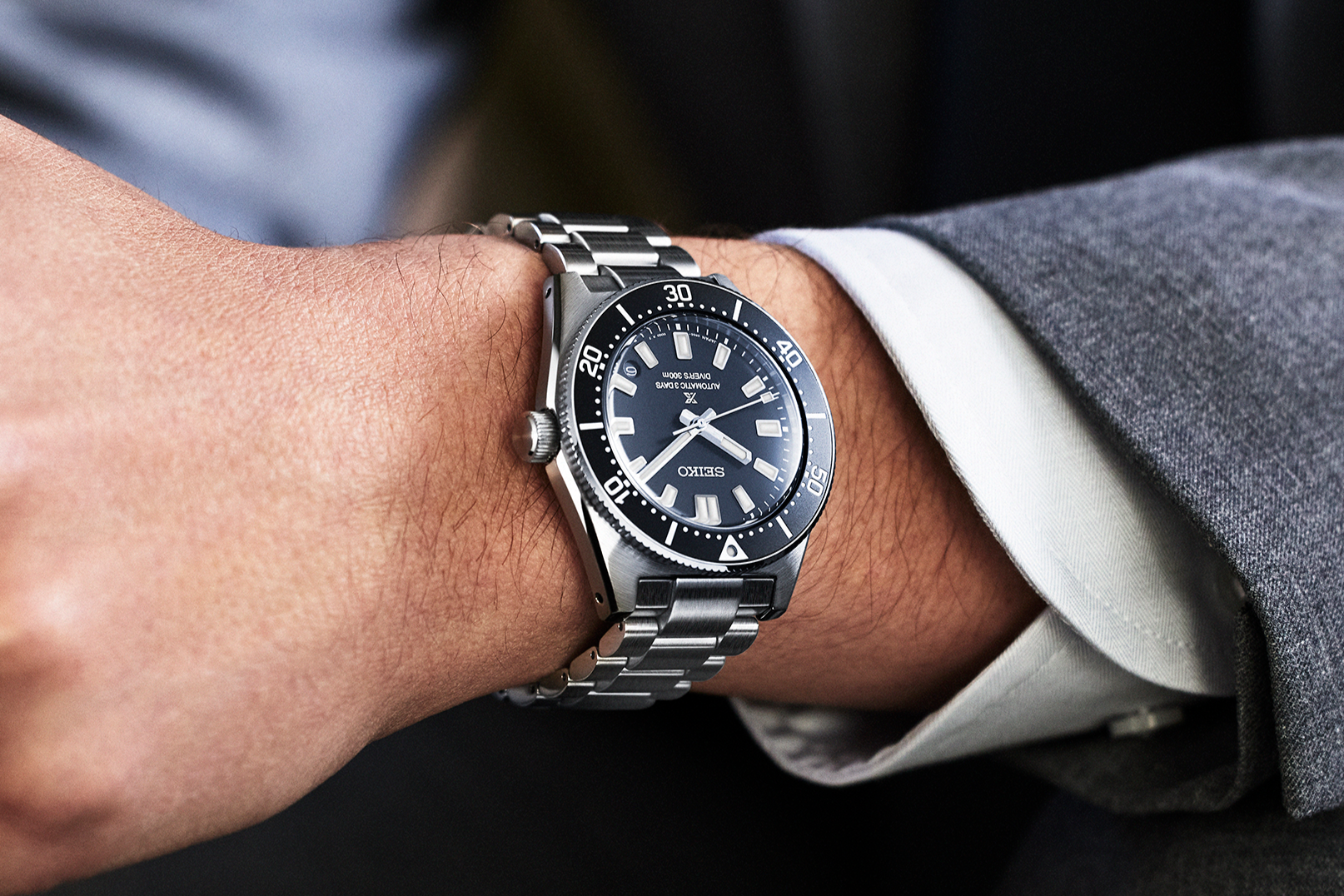
The one arena in which positively enormous proportions do not particularly matter on a dive watch is in the actual act of diving. The watch is worn over a wetsuit, which typically, though not always, has long sleeves. Thus, sitting proud of several millimeters of neoprene, the timepiece in question has no need to “slip under a cuff” or to “be framed by one’s wrist” or any of the other elegant crap I typically advocate for in a daily wearer. No. In this case, you want a watch that is highly legible and tough as nails, and this means a larger case is just fine.
I, for example, typically have no desire to wear any watch with a diameter larger than 42mm. Underwater, however, this rule melts away. Forty-six millimeter Panerai? Strap it on. Forty-five millimeter Omega? I will take it. (For diving.) You want to be able to see the dial, and a large case often facilitates this.
With respect to case dimensions excluding diameter: lug-to-lug often increases proportionally with diameter and, once again, this is not a problem when the watch is perched atop your wetsuit and being used exclusively as an underwater timing instrument. Same with thickness: while thinner is, to my mind, generally better, increased water resistance often comes with a thicker housing. With respect to lug width: provided that you have a well-made rubber dive strap or bracelet, it does not really matter what it is. (What you do not want to do is dive with a watch on a NATO-style strap: it will invariably work its way loose, and you may find yourself desperately trying to intercept a Submariner on its way down to the Mariana Trench while simultaneously filming your buddy talking to a lemon shark on your GoPro.)
Six Watches I’d Actually Dive With
Citizen Promaster Diver BN0150-28E
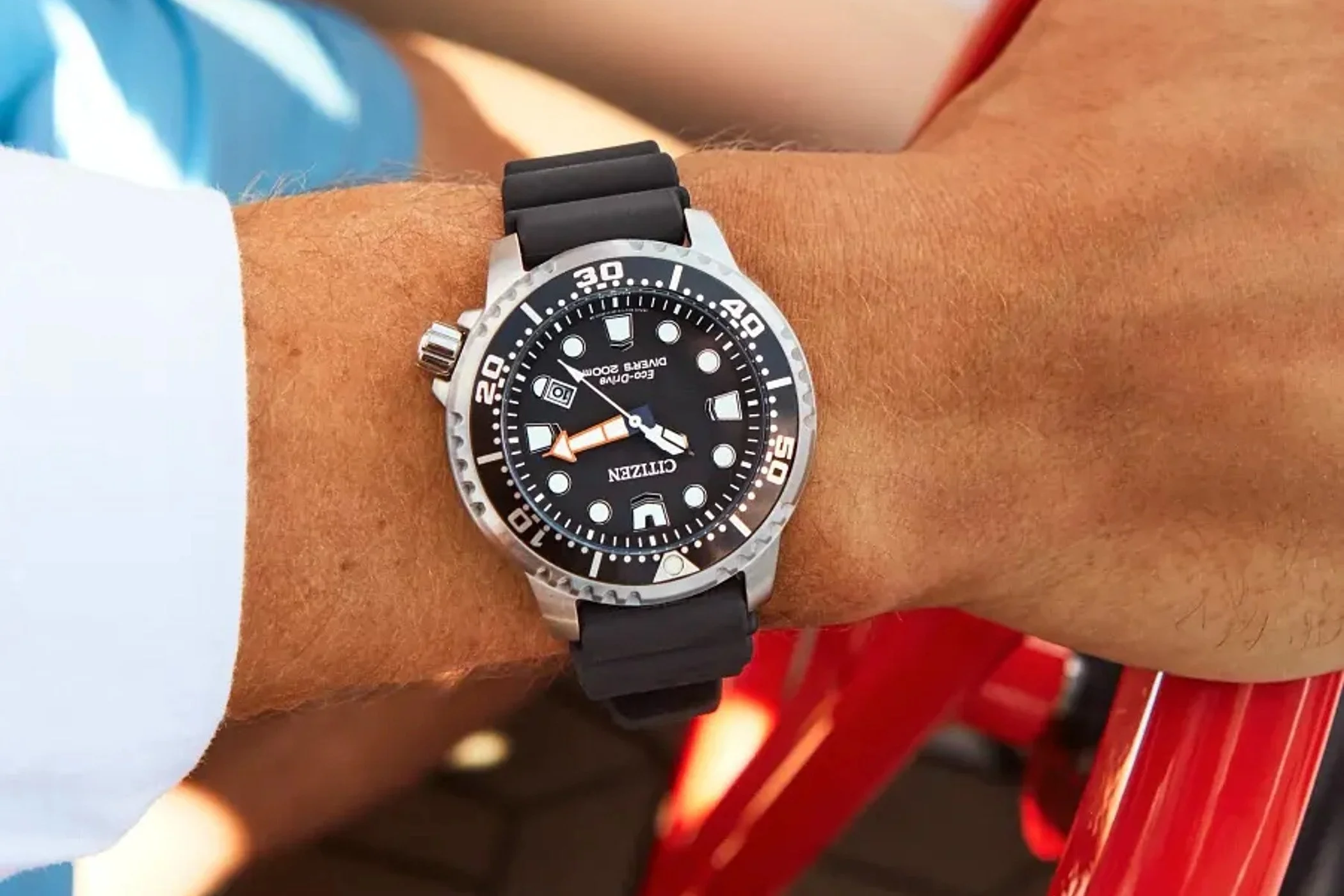
Case Size: 44mm, Thickness: 11.5mm, Lug-to-Lug: 48mm, Movement: Citizen Eco-Drive Cal. E168 Solar Quartz, Water Resistance: 200m, Price: $450 USD
Not all heroes wear capes, and not all dive watches are mechanical. The Citizen Promaster ref. BN0150-28E is one of the few quartz-powered divers that salty old sea dogs begrudgingly respect, and here is why: with its oversized case, its fully hashed bezel insert, its oversized, luminous indices, and its bright orange minute hand, it is clearly designed to do a single job, to do it well, and to take no prisoners. Also? Its Eco-Drive movement charges via ambient light, meaning you will hardly ever need to change its battery. How much does all this cost, you might ask? Less than $500. That is right: one of the best divers is also one of the cheapest.
The Citizen Promaster Diver BN0150-28E lists at $450 USD and is regularly on sale for $360.
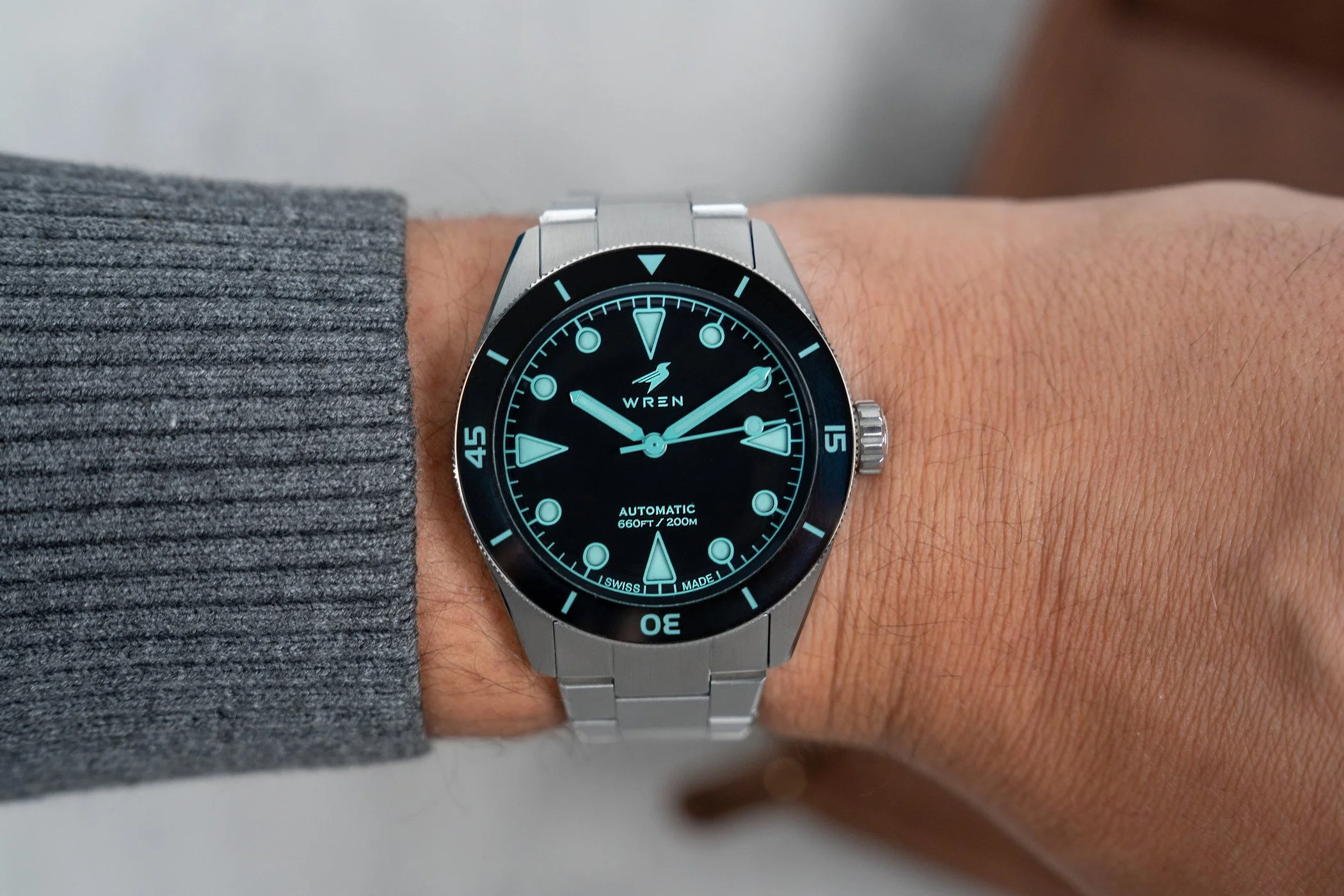
Wren Diver One Titanium Glacier
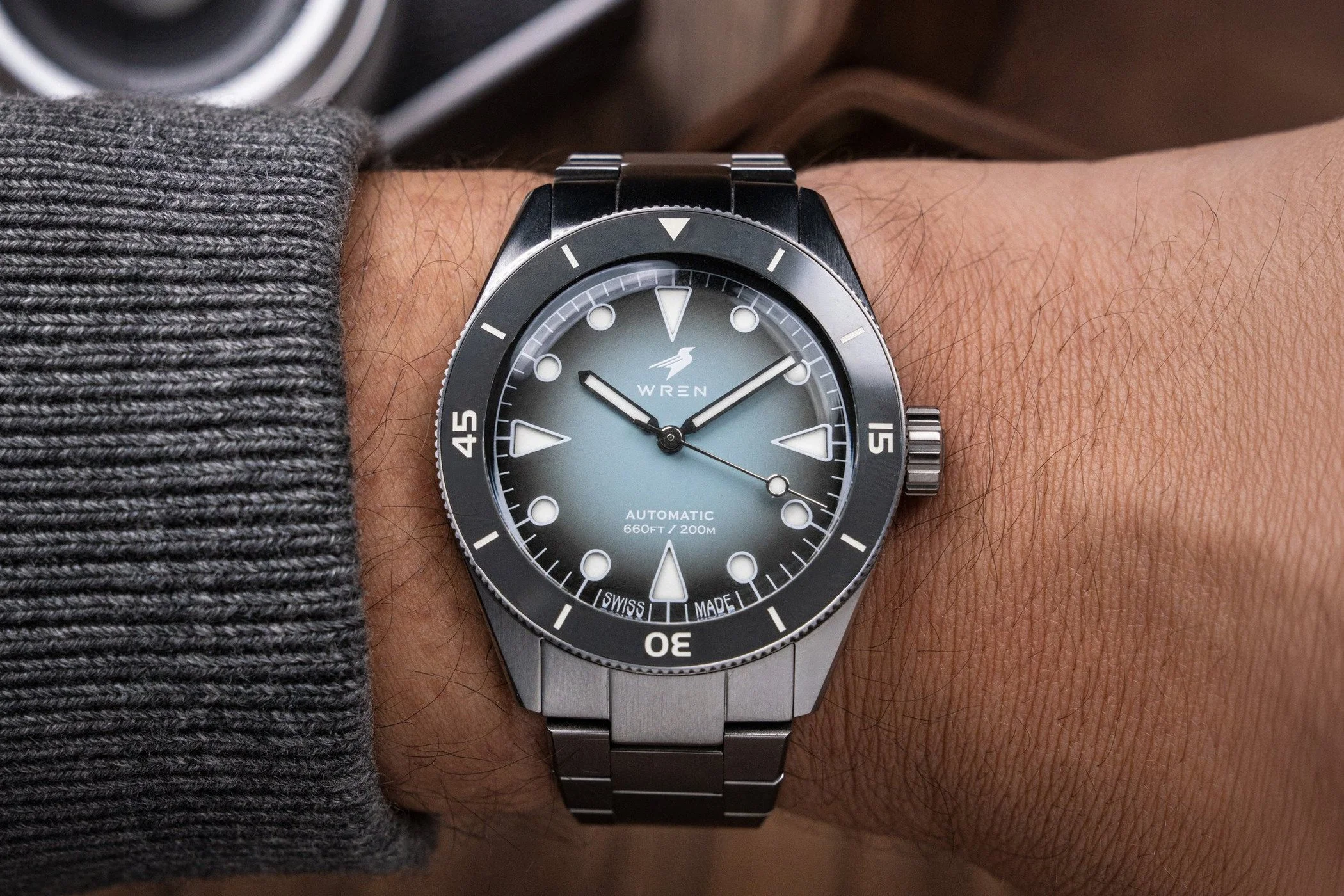
Case Size: 41mm, Thickness: 12.4mm, Lug-to-Lug: 47mm, Material: DLC-Coated Grade 5 Titanium, Movement: ETA Cal. 2824 Automatic, Water Resistance: 200m, Price: $1,495 USD
You will forgive us tooting our own horn here, but we think we make a pretty darn good dive watch. The Wren Diver One Titanium Glacier takes some of the load off your wrist with lightweight construction, manageable dimensions, and a lovely matching multi-link bracelet. A DLC coating lends a hard-wearing finish, while a fully lumed ceramic bezel insert and a cool grey-black, glacier-inspired dial with luminous indices promise legibility even at depth. Powered by the classic Swiss ETA 2824 automatic movement, it even comes with an additional FKM rubber strap. Svelte enough for everyday wear, it is an ideal underwater companion.
The Wren Diver One Titanium Glacier costs $1,495 USD on the titanium bracelet, with the rubber strap in the box.
Doxa SUB 300 Professional
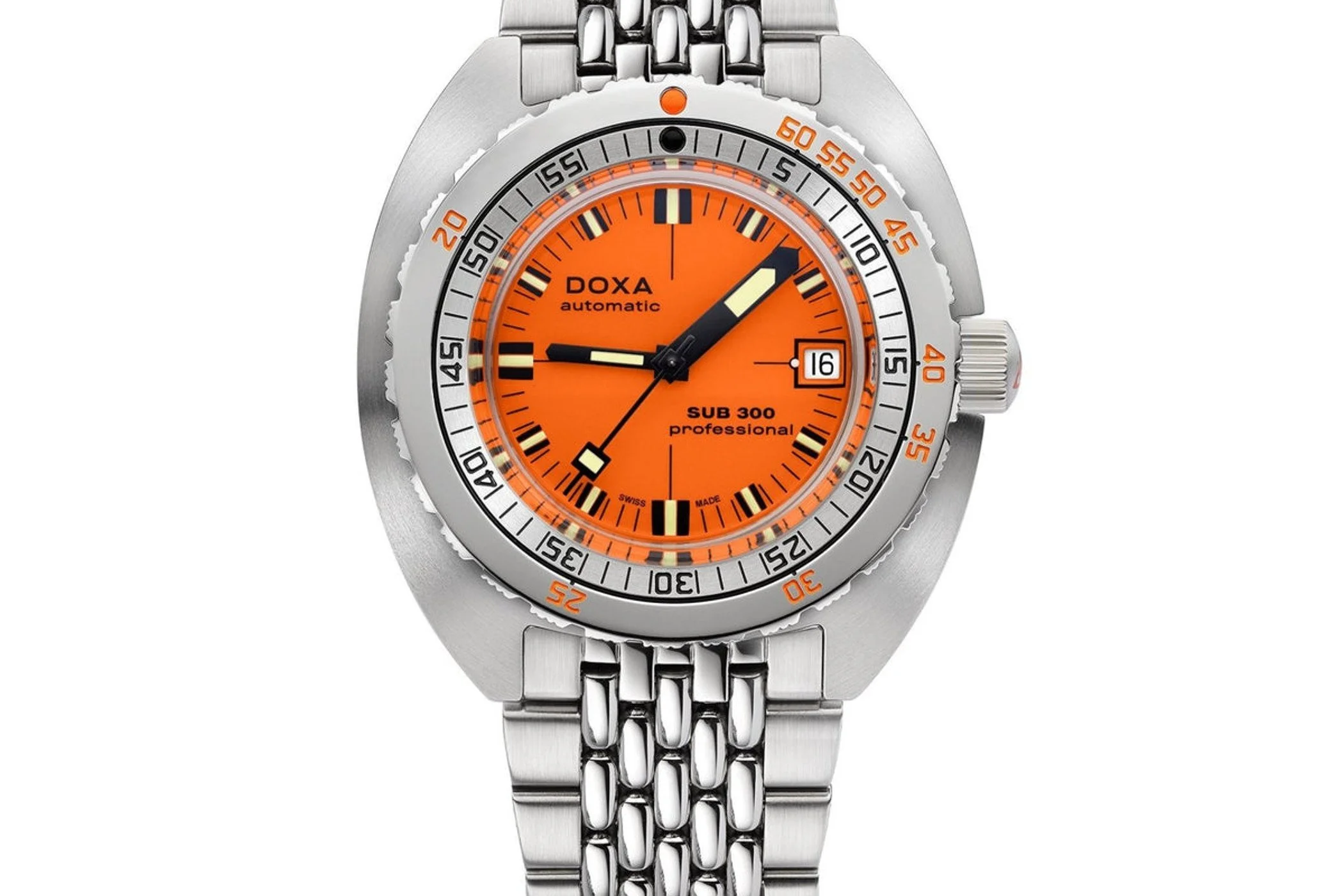
Case Size: 42.5mm, Thickness: 13.4mm, Lug-to-Lug: 45mm, Movement: ETA Cal. 2824-2 Automatic, COSC Chronometer, Water Resistance: 300m, Price: $2,890 USD
The funky design of Doxa’s SUB 300 can be polarizing while topside, but below the waves, every diver worth his salt knows that it is one of the best professional instruments ever made. Its famous “no-deco” bezel was designed using U.S. Navy dive tables to inform divers how long they can stay submerged at a given depth without a decompression stop, while its oversized cushion case, significant water resistance, and bright dial hues, such as the orange “Professional” colorway, are famous. Available in numerous guises, we would recommend it on its classic beads-of-rice bracelet, which lends a touch of class while at the beachside bar.
The Doxa SUB 300 Professional costs $2,890 USD on the beads-of-rice bracelet and $2,850 USD on rubber.
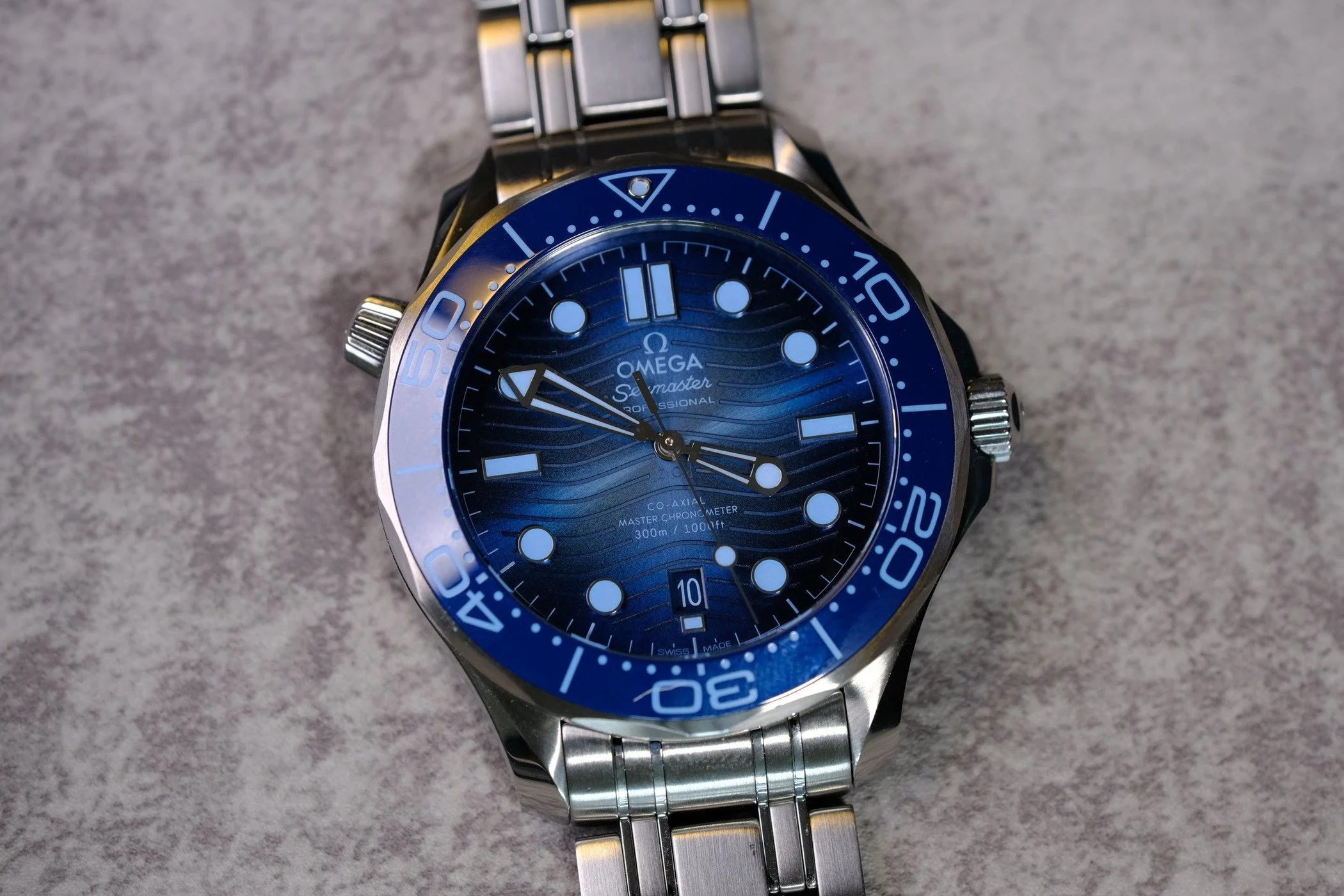
Omega Seamaster Diver 300M
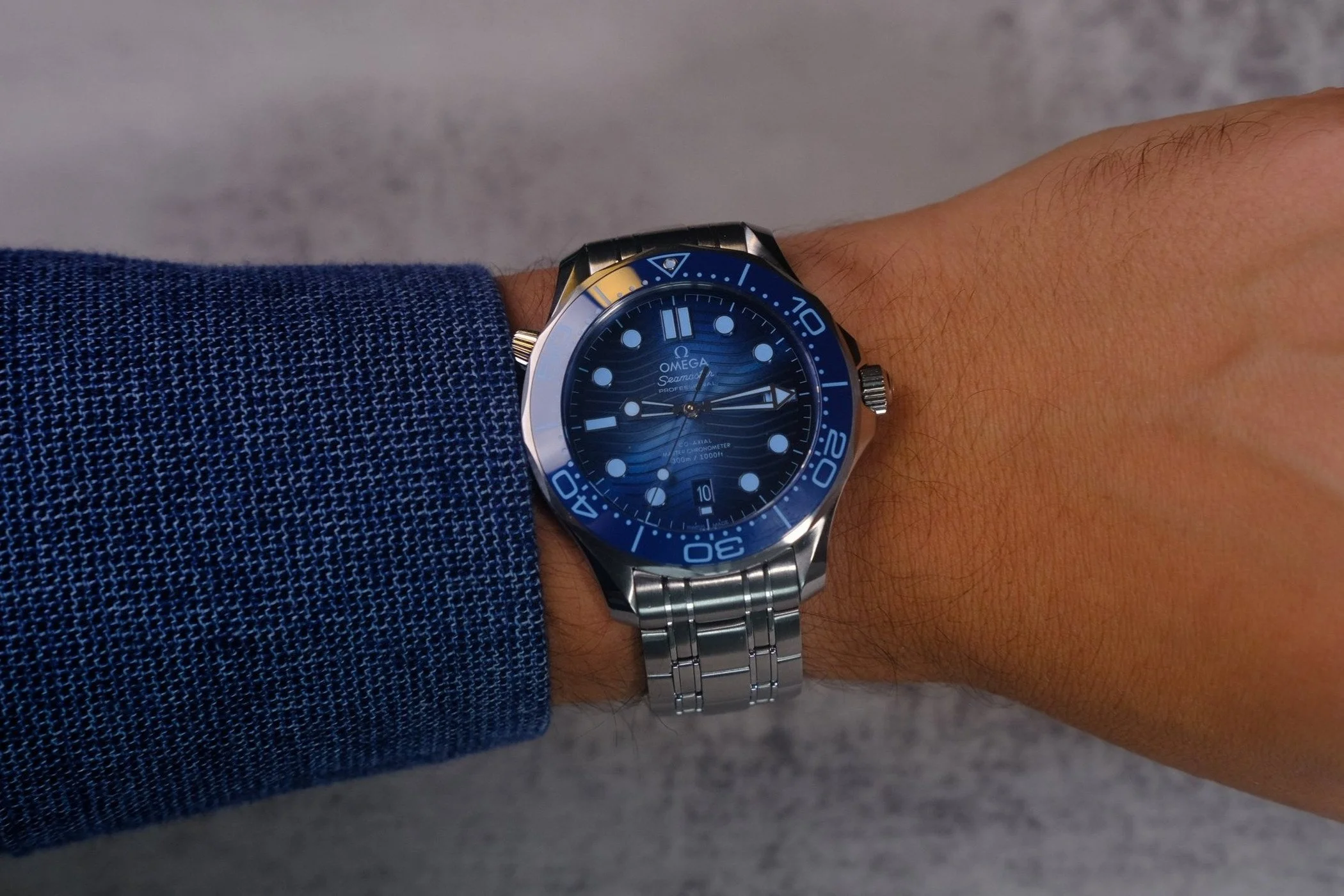
Case Size: 42mm, Thickness: 13.6mm, Lug-to-Lug: 49.9mm, Movement: Omega Cal. 8800 Co-Axial Master Chronometer, Water Resistance: 300m, Price: $6,300 USD
With a diameter of 42mm, a case height of 13.6mm, and a lug-to-lug of 49.9mm, the Omega Seamaster Diver 300M is a big boy, but attached firmly to its blue rubber dive strap, it is one of the most capable timekeepers in the ocean. The blue “wave” dial is practically begging to spend its life in and around the water, while a helium escape valve is present at 10 o’clock just in case you decide to take this whole “diving” thing to its logical conclusion and begin welding pipe at the bottom of the North Sea for a living. Powered by a killer Master Chronometer movement, the Seamaster Diver, like the Sub, is a one-and-done kind of watch.
The Omega Seamaster Diver 300M costs $6,300 USD on the blue rubber strap.
Rolex Submariner
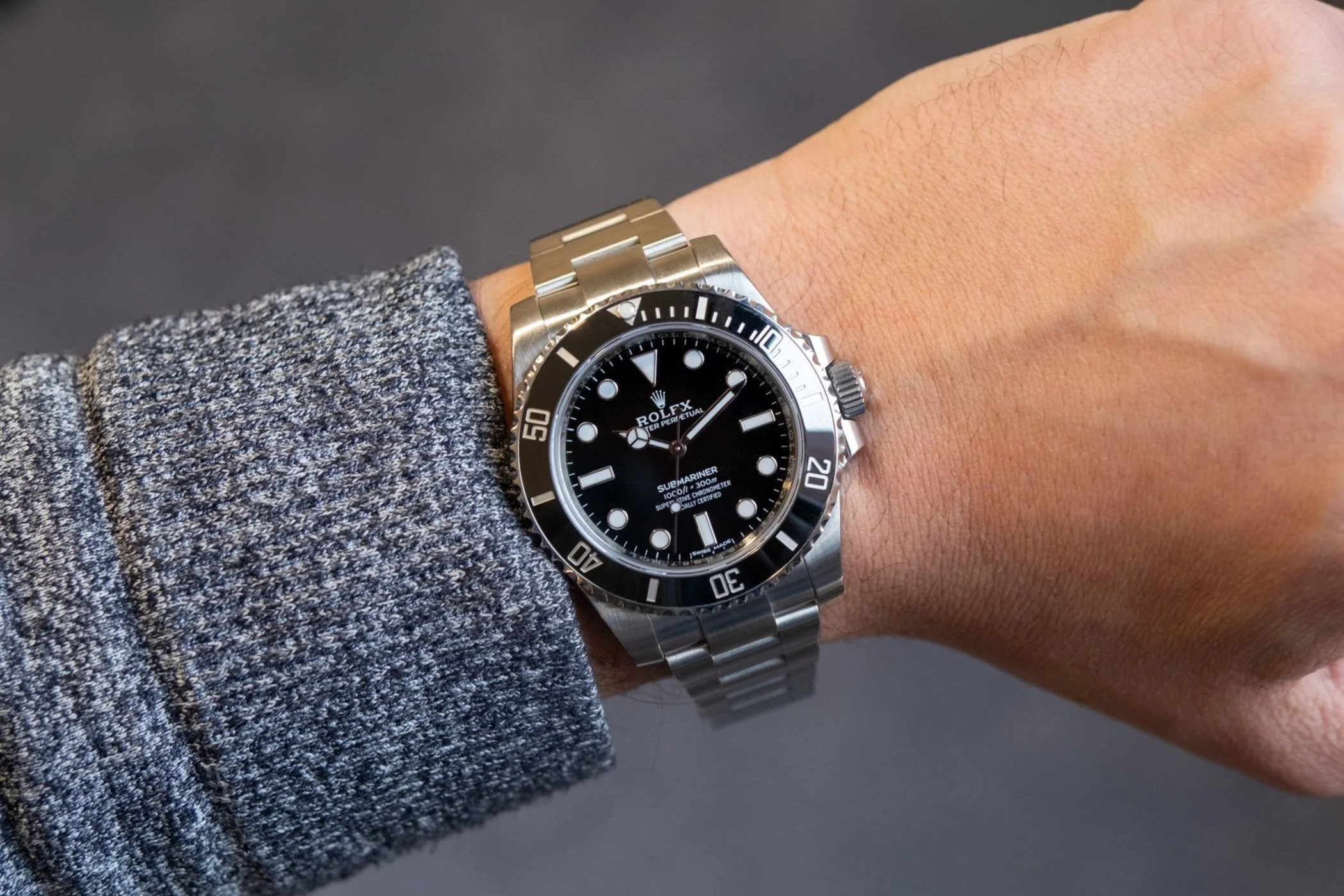
Case Size: 41mm, Thickness: 12.3mm, Lug-to-Lug: 47.6mm, Movement: Rolex Cal. 3230 Automatic, Power Reserve: 70 Hours, Water Resistance: 300m, Price: $10,050 USD
If you, like me, are looking to cosplay like a 1950s skin diver and to get called out on an actual dive boat for wearing not only an analog watch, but one that is ostensibly way too expensive to risk losing at the bottom of the ocean, then the Rolex Submariner is for you. The modern ref. 124060 boasts a Cerachrom bezel insert, the Rolex cal. 3230 automatic movement with 70 hours of power reserve, and a matching Oyster bracelet with a Glidelock clasp for on-the-fly adjustment. It is handsome; it is built like an Abrams tank; and it works. What else you could possibly want in a tool watch, I have not the foggiest.
The Rolex Submariner ref. 124060 costs $10,050 USD.
Blancpain Fifty Fathoms Automatique
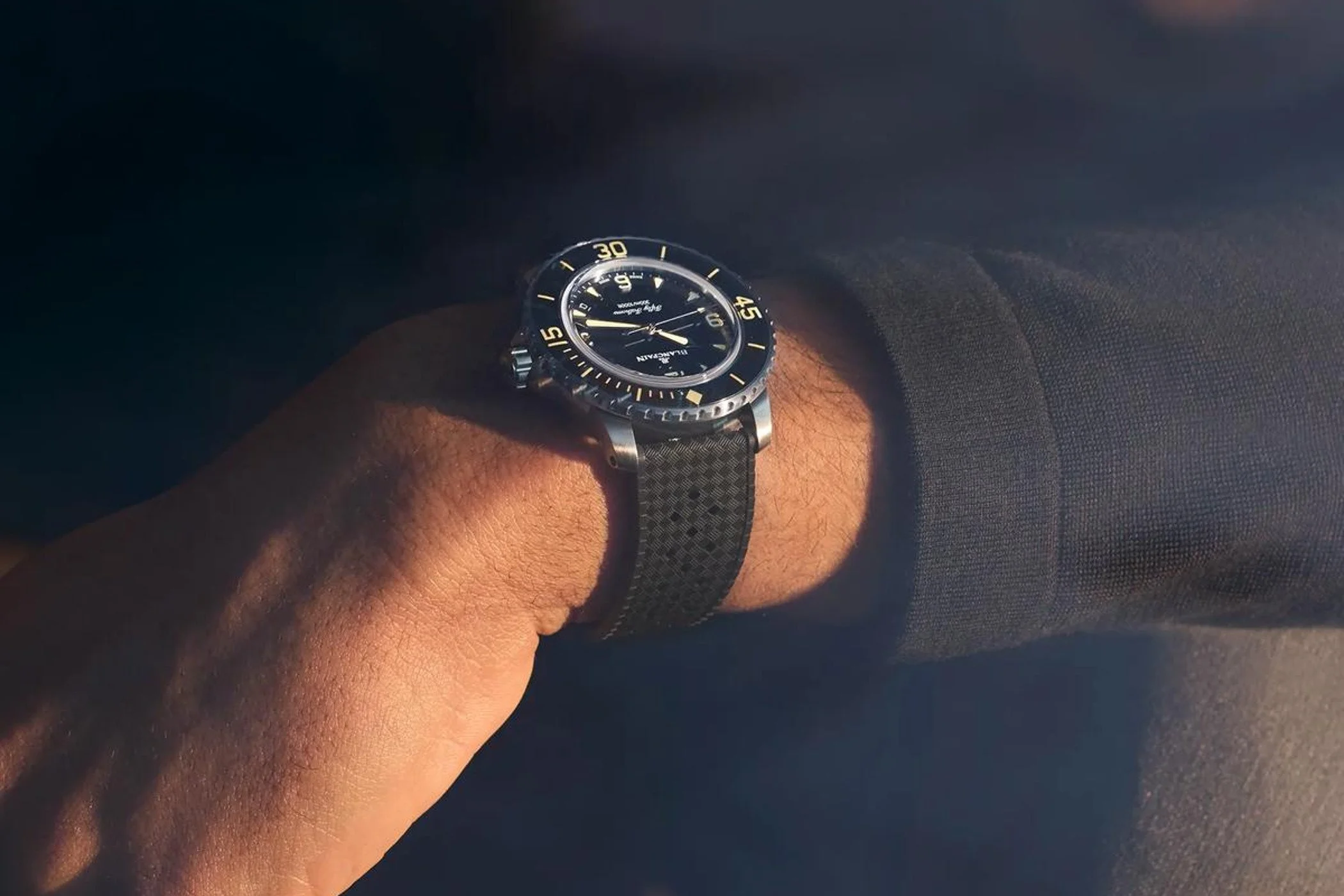
Case Size: 42.3mm, Thickness: 14.3mm, Lug-to-Lug: 48mm, Material: Titanium, Movement: Blancpain Cal. 1315 Automatic, Power Reserve: 120 Hours, Water Resistance: 300m, Price: $20,300 USD
If you really wanna take your dive-watch game to the next level, you could always splash out for the modern version of an OG classic, the Blancpain Fifty Fathoms. One of the first commercially available dive watches released during the 1950s, it has been updated in the form of the Automatique, a hefty 42.3mm titanium instrument powered by the in-house Blancpain cal. 1315 movement with a whopping 120 hours (five days) of power reserve. Paired to a vintage-style rubber dive strap, it boasts a sapphire-crystal bezel insert that gives it the look of a midcentury watch, even if it is loaded with the absolute latest in horological tech.
The Blancpain Fifty Fathoms Automatique costs $20,300 USD on the rubber strap.