
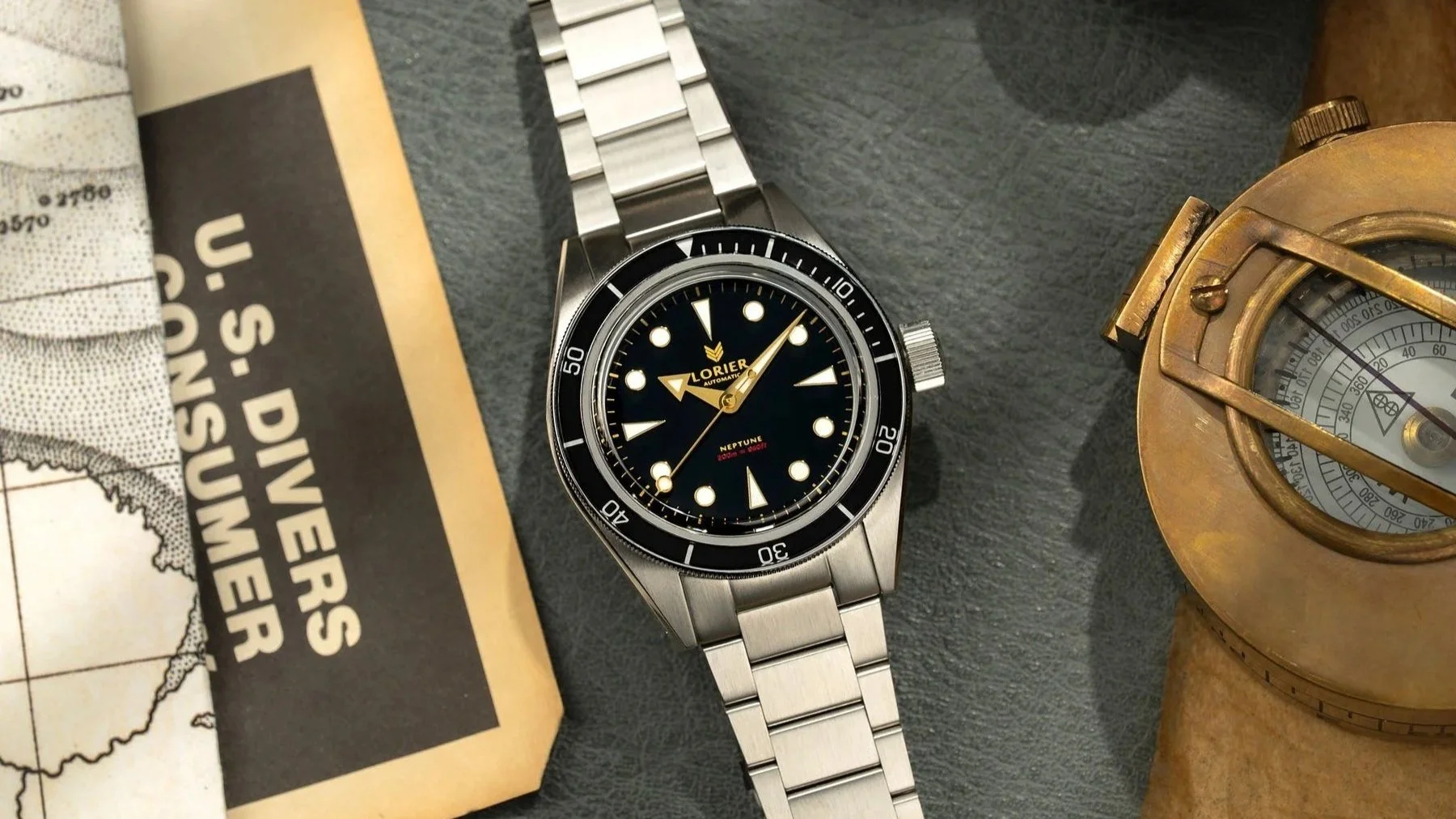
For years, the hardest part of buying a Lorier was finding one. The New York microbrand made vintage-sized watches that looked like they came out of the 1950s and sold for well under $1,000, and every restock sold out in hours. Then the brand went quiet. In July 2026 it came back with a new owner, a new core collection and, for the first time, sapphire crystals.
If you have been waiting for a Neptune to come back in stock, or you just saw the name on Reddit and want to know what the fuss is about, here is everything you need to know about Lorier, who owns it now and what the four relaunched watches are like.
Who Is Behind Lorier?
Lorier was founded in New York City in 2017 by Lorenzo and Lauren Ortega, a husband and wife team who loved vintage watches and wanted to make new ones that felt the same way. The idea was simple. Mid-century case sizes, designs that fit the era without copying one specific watch, and prices that made them tools rather than status symbols.
It worked a little too well. For most of the brand's life the problem was not selling watches, it was making enough of them. A two-person operation could not keep up, drops disappeared in hours and the waiting became part of the brand's reputation.
That is why the next part happened. On July 20, 2026, Worn & Wound announced that it had acquired Lorier. The Ortegas stay on as partial owners, Lorenzo is now Creative Director, and Lorier gets Worn & Wound's customer service, fulfillment and logistics behind it. The first new hire was Ilya Ryvin as General Manager, who was Worn & Wound's first employee and spent several years at Grand Seiko after that. Worn & Wound also owns Windup Watch Shop and the Windup Watch Fair, so this is a publication that already knew how to sell watches.
If a watch site owning a watch brand sounds familiar, it should. I own this one and Wren, so I am the last person who is going to throw stones. I will just say that when you read a Lorier review on Worn & Wound from here on out, you know where it is coming from.
Where Are Lorier Watches Made?
Lorier watches are designed in New York and ship from Brooklyn. Every component other than the movement is designed to Lorier's own specifications rather than pulled from a catalog, which is rarer at this price than you would think. The movements are Japanese Miyota 9000 series automatics across the board. Lorier does not say where the cases are produced, and I would not expect it to at these prices.
The biggest change with the relaunch is the crystal. The old Loriers used domed acrylic, which gave them a lot of their vintage charm and most of their scratches. The new ones use domed sapphire with a seven-layer anti-reflective coating, and the Neptune and Hyperion get sapphire bezel inserts as well. Every model comes on a solid steel bracelet that tapers from 20mm to 16mm, with screw pins, drilled lugs and a quick-adjust clasp. The screwdriver is in the box.
The Dive Watch: Neptune
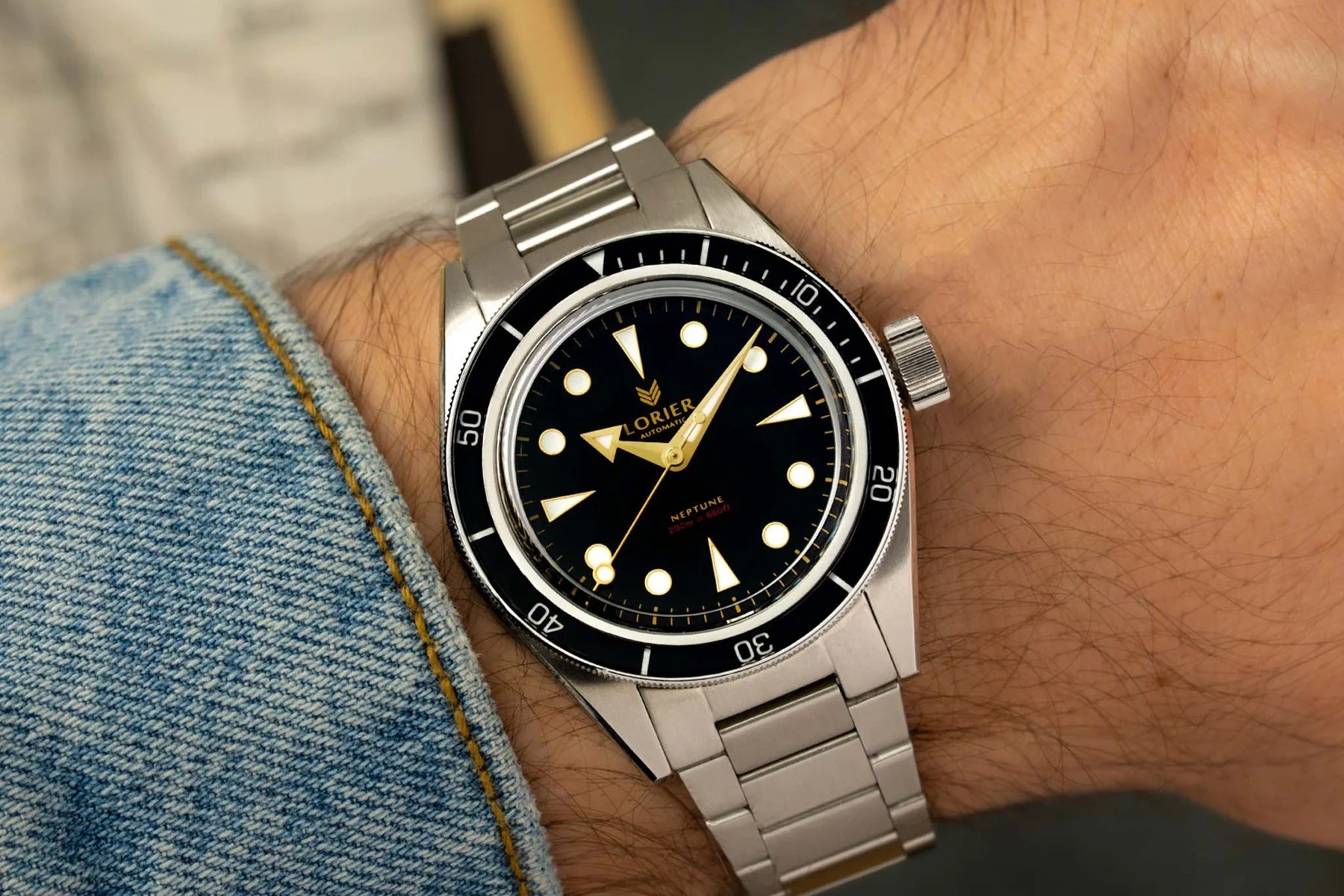
Case Size: 39mm (37mm bezel), Thickness: 10.3mm plus 1.1mm domed crystal, Lug-to-Lug: 46mm, Movement: Miyota 9039 Automatic, Water Resistance: 200m, Crystal: Domed Sapphire, Price: $699 USD
The Neptune is the watch that made Lorier, and it is the one to start with. It is a dive watch from the golden era of dive watches, which is to say it borrows a little from the early Submariners, a little from the Seiko 62MAS and the hands from an old Seamaster 300, without being a copy of any of them. Gilt accents, a black dial and a thin bezel that sits well inside the 39mm case.
The details are what you pay for. The bezel is unidirectional with 120 clicks, which is how I think every dive bezel should be. The bezel insert is now sapphire instead of aluminum, so it will not scratch in the strap-change drawer, and the crown screws down for 200 meters of water resistance. At 10.3mm thick it is thinner than most of the dive watches under $1,000 I usually recommend.
The Neptune costs $699 USD on a bracelet. It is on pre-order with shipping expected in late December 2026.
The GMT: Hyperion
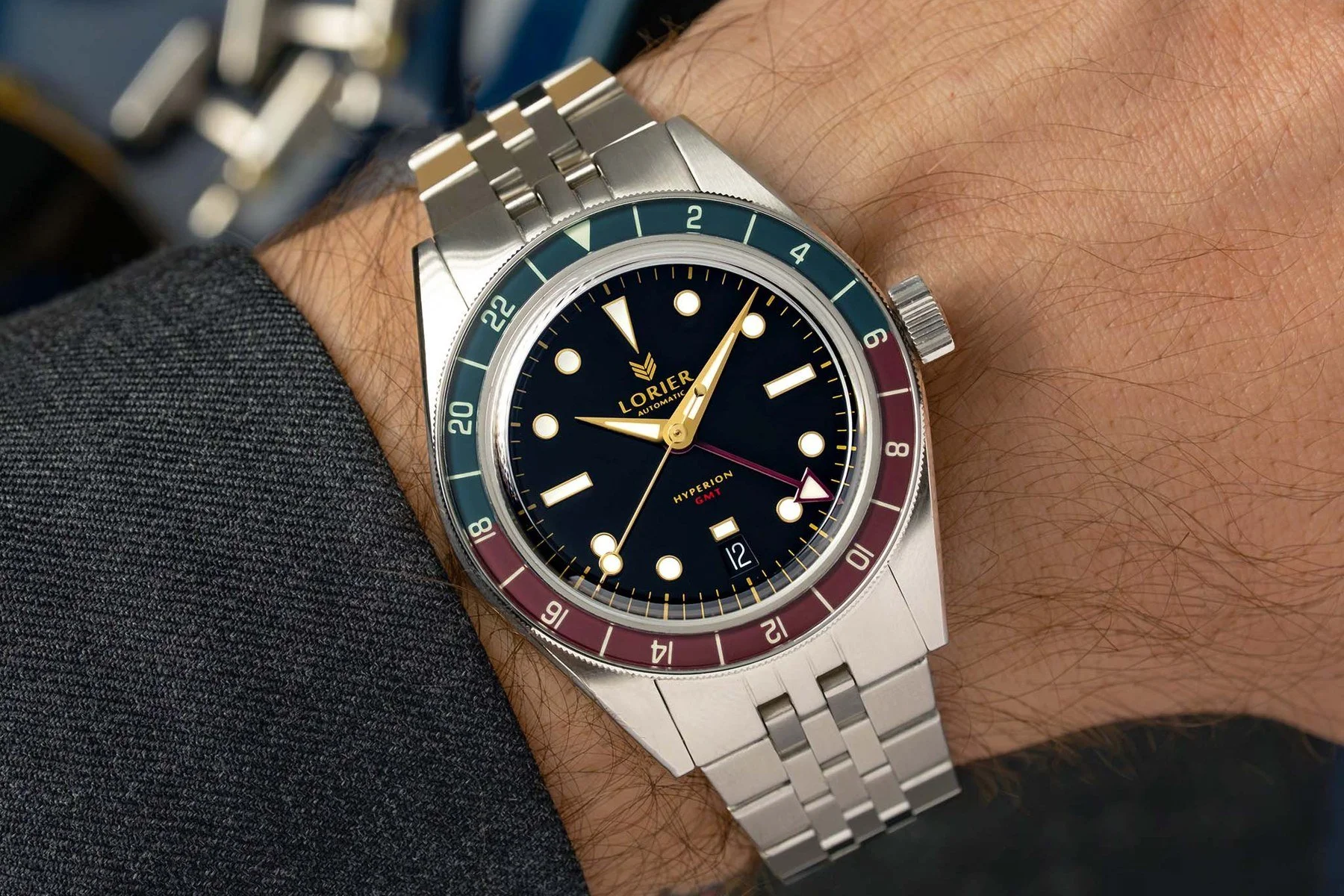
Case Size: 39mm (37mm bezel), Thickness: 10.7mm plus 1.45mm domed crystal, Lug-to-Lug: 46mm, Movement: Miyota 9075 Automatic GMT, Water Resistance: 100m, Crystal: Domed Sapphire, Price: $799 USD
The Hyperion is the Neptune's traveling cousin. Same 39mm case, but with a red and blue bidirectional 24-click bezel, a glossy black dial with gilt accents and an arrow-tipped GMT hand. You know what it is referencing, and so does Lorier.
What makes it interesting at this price is the movement. The Miyota 9075 is a true GMT, meaning the local hour hand jumps independently when you land somewhere new, which is the way a travel watch should work and something you usually pay a lot more for. For those of you who have been looking for a GMT watch with a flyer's movement under $1,000, the list is short and this is on it.
The Hyperion costs $799 USD on a bracelet, on pre-order with shipping expected in January 2027.
The Field Watch: Falcon
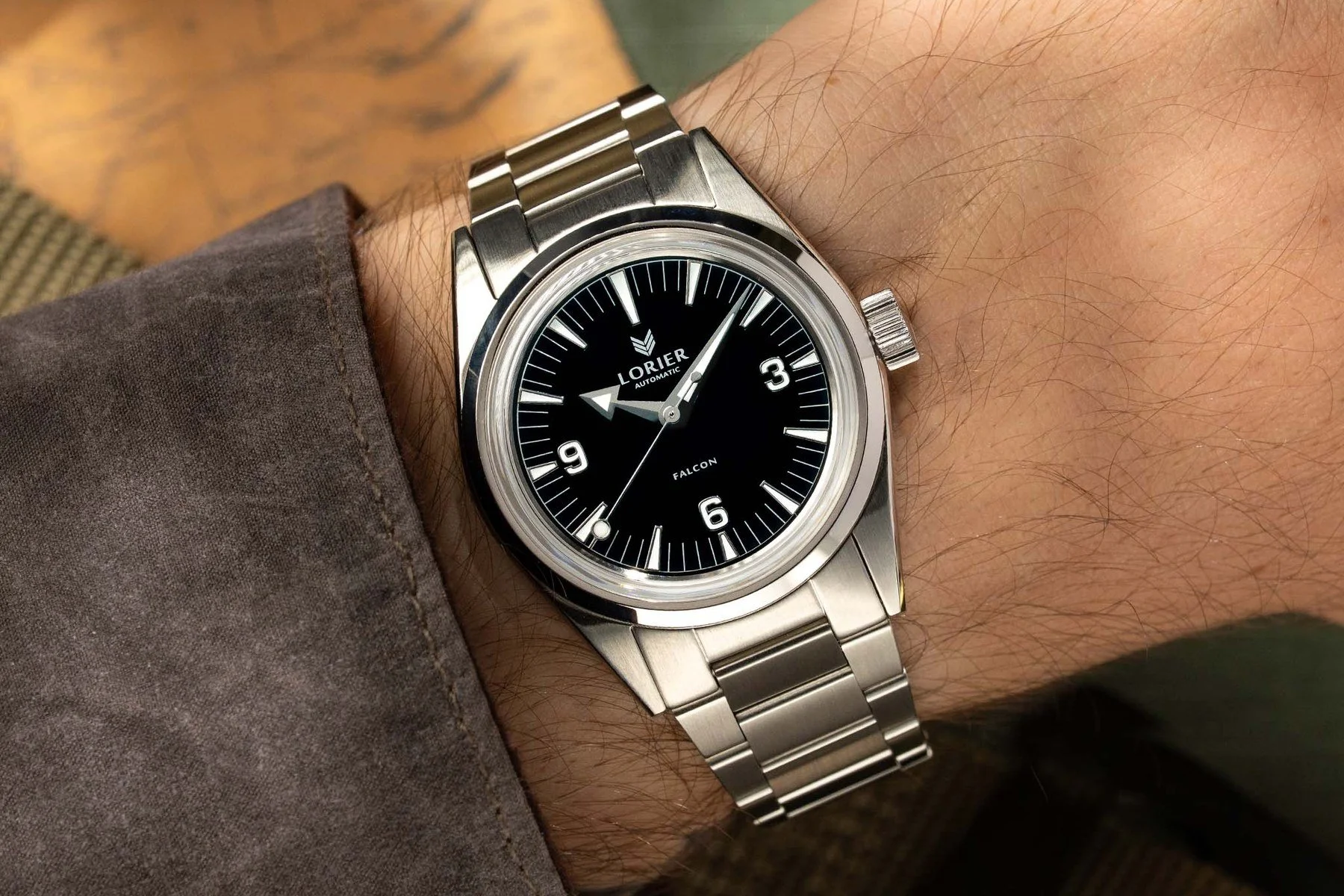
Case Size: 36mm, Thickness: 8.8mm plus 1.6mm domed crystal, Lug-to-Lug: 44mm, Movement: Miyota 9039 Automatic, Water Resistance: 100m, Crystal: Domed Sapphire, Price: $699 USD
The Falcon is Lorier's field watch, and really its everyday all-rounder. It has the classic 3-6-9 dial you know from the Explorer, with faceted broad-arrow hands and squared applied indices, in a 36mm case with chamfered edges. Lorier says 36mm is the ideal size for a watch with a fixed bezel, and on paper a 36mm case with a 44mm lug-to-lug is about as wearable as a field watch gets on my 6.75 inch wrist.
It also has a screw-down crown and 100 meters of water resistance, so it is more capable than the dress-watch proportions suggest.
The Falcon costs $699 USD on a bracelet, on pre-order with shipping expected in late December 2026.
The Dress Watch: Astra
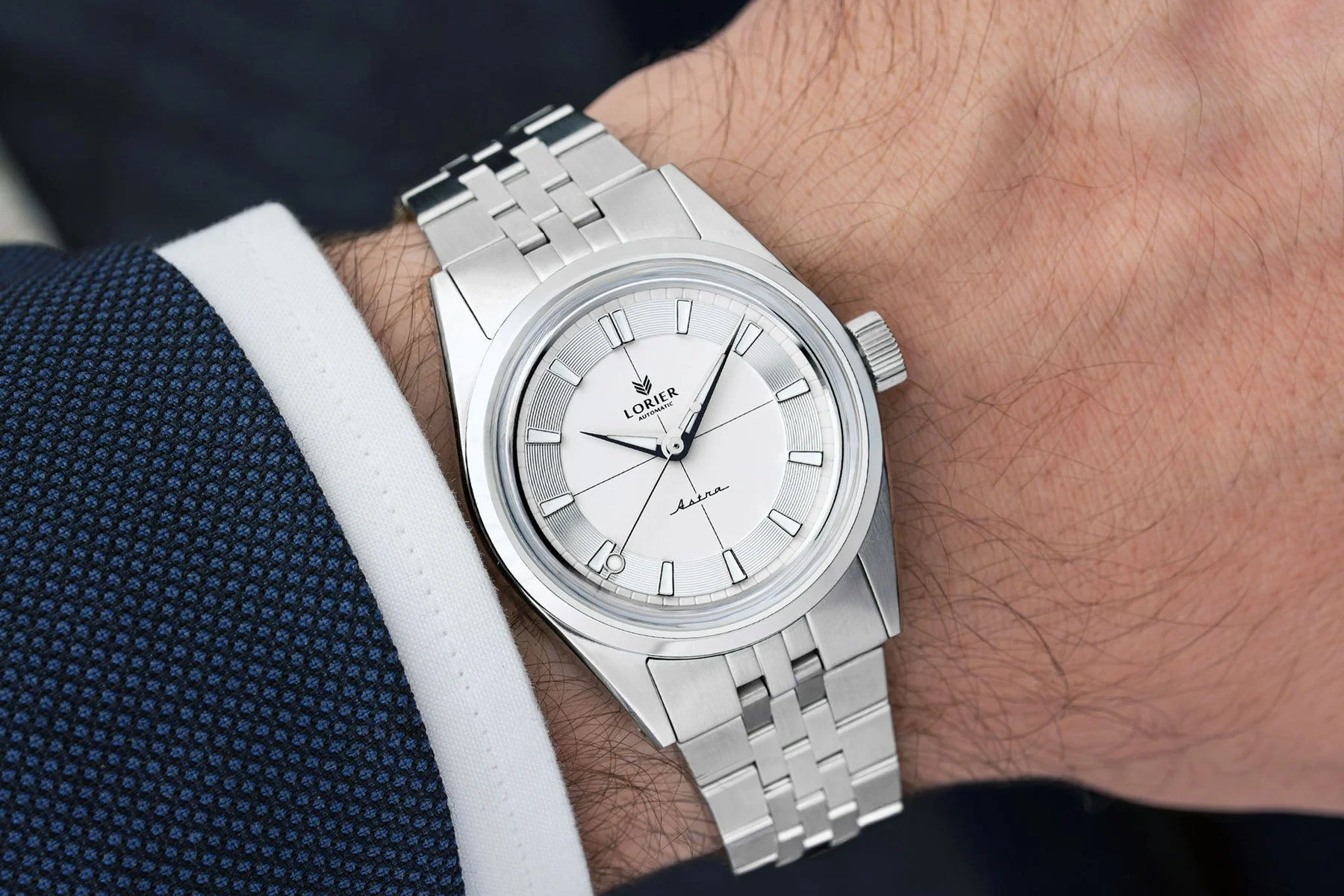
Case Size: 36mm, Thickness: 8.8mm plus 1.6mm domed crystal, Lug-to-Lug: 44mm, Movement: Miyota 9039 Automatic, Water Resistance: 100m, Crystal: Domed Sapphire, Price: $699 USD
The Astra shares the Falcon's case but goes in the opposite direction. It is Lorier's answer to a 1960s dress watch, with a silver pie-pan dial, a printed crosshair, faceted dauphine hands and a five-link bracelet instead of the three-link. The minute track is fully lumed, which you do not see on many dress watches under $1,000, and there is no date window to interrupt the dial (the previous version had one, and some people will miss it).
With 100 meters of water resistance and a sapphire crystal, it is a dress watch you can actually wear every day, which is the whole idea behind the brand.
The Astra costs $699 USD on a bracelet, on pre-order with shipping expected in late December 2026.
Are Lorier Watches Good?
Yes. Lorier was one of the first microbrands to get the proportions right, and the relaunch fixes the one thing people used to complain about, the acrylic crystal. You get a custom case and bracelet, a Miyota 9000 series movement, BGW9 lume, 100 to 200 meters of water resistance and a quick-adjust clasp for $699 USD. There are not many brands doing that.
With that being said, there are a few things to know going in. The warranty is 12 months, where two years has become the norm. Everything is on pre-order with ship dates in late December and January, and Lorier's history says the next batch will sell out too (Worn & Wound's own words were "this will take time"). The prices are higher than they were on the old versions, so if you loved Lorier at $499, this is not that. And if the acrylic crystal was the reason you loved them, the sapphire is a different watch. I think it is the better watch, but I understand the argument.
I would also keep an eye on how the brand changes now that it is part of a bigger company. The Ortegas are still designing the watches, which is the part that matters, and the first four releases say they are not messing with what worked.
How Much Do Lorier Watches Cost?
Lorier watches cost $699 USD for the Neptune, Falcon and Astra and $799 USD for the Hyperion. Every one comes on the steel bracelet, so there is nothing to add unless you want a strap. Lorier's own straps run $25 USD to $150 USD, from nylon to Horween shell cordovan.
Where should you buy one? Directly from Lorier is the answer, since everything ships from Brooklyn and there is no import math to do. The catch is that all four models are on pre-order as I write this, so you are buying a place in line. Windup Watch Shop, which has the same owner, also carries the brand and has a showroom in New York City where you can try them on before you commit. If you want one sooner, the older acrylic-crystal versions show up on the secondhand market regularly, usually for less than the new price.
All-in-all, Lorier is still one of the best values in vintage-inspired watches. It just has a new address.