
Before getting into Wren, I should make an important disclosure. I founded and own Wren Watches, and it operates under the same company as Wrist Enthusiast. Obviously, that means I have a personal interest in the brand, and I want to be transparent about that. But I also think there is value in covering Wren in the same way we cover other independent brands, particularly since I've been asked quite a bit about the watches and the thinking behind them. I'll go through the history, specifications, pricing and different models, as well as some of the trade-offs involved in their designs. Just keep in mind that I'm coming at this from a different perspective than I would with a brand I have no involvement in.
Wren is a New York-based independent watch brand that produces Swiss-made watches in relatively small quantities, often limited to just 100 pieces per model. The collection started with the Diver One, a 41mm dive watch (currently priced at $1,195 USD), and has since expanded to include smaller divers, titanium models and the Vessel, our first integrated-bracelet sports watch, which launched in October 2026 with prices starting at $2,900 USD. Across the lineup, we've focused on distinctive designs, high-quality materials and details that aren't necessarily common at these price points. Here's everything you need to know about Wren, including how it started and what makes the watches different.
Who Is Behind Wren?
I am. Before starting Wren, I spent twelve years working as a litigation attorney in New York. I started Wrist Enthusiast while I was still practicing law, and eventually it grew to the point where I could focus on watches full-time.
After spending years reviewing and writing about watches, I had developed some pretty specific opinions about what I liked, what I didn't like and what I thought could be done differently. Starting my own brand was something I had considered for a while, and in 2024 I finally decided to do it.
The first watch was the Wren Diver One Aqua, a 41mm Swiss-made dive watch that launched at $965 USD. We produced 100 pieces, and the entire edition sold out. Since then, we've introduced several variations of the Diver One, a smaller 38mm collection and, most recently, the Vessel.
For the most part, Wren's designs have come directly from me, although I worked with designer Max Resnick on the Vessel. Max is also known for his work on the Anoma A1 and VPC watches. We spent roughly two years developing the Vessel together, with the goal of creating something that looked and felt different from the many integrated-bracelet watches already on the market.
One thing that has shaped Wren from the beginning is the community around Wrist Enthusiast. Unlike many newer watch brands, Wren didn't start with a Kickstarter campaign or a large marketing budget. We already had an audience of watch enthusiasts, many of whom became our first customers. Their feedback has also influenced the direction of the brand.
For example, the Diver 38 came about largely because people liked the Diver One but wanted something smaller and thinner. Similarly, we received requests for a black-dial Diver One for nearly two years before finally introducing the Abyss.
We've also generally kept production relatively limited, with many models produced in individually numbered editions of 100 pieces. Some sell out quickly, while others remain available for longer. And because of the time involved in Swiss manufacturing and assembly, it can take months to produce additional watches. We've also maintained a policy of not discounting our watches, something I believe is important for a small independent brand.
Where Are Wren Watches Made?
All Wren watches are Swiss Made. Although the brand is based in New York and the designs originate here, our watches are assembled and undergo final inspection in Switzerland, using Swiss mechanical movements. Meeting the requirements for the Swiss Made designation was something I wanted to prioritize from the beginning, particularly given the quality of Swiss watchmaking and the experience of the manufacturers we work with.
We also use movements from established Swiss manufacturers, which makes long-term servicing and maintenance relatively straightforward. The steel Diver One uses the Sellita SW200, while the titanium versions use the ETA 2824. The Diver 38 initially used the ETA 2892-A2, and we've since transitioned to the Sellita SW300-1, which offers a longer 56-hour power reserve. The Vessel also uses the SW300-1.
These are all proven automatic movements, and one of the benefits of using established calibers from ETA and Sellita is that owners shouldn't have to rely exclusively on Wren for servicing years down the road.
Beyond the movements, there are a few manufacturing details we've tried to incorporate across the collection.
One is the clear DLC coating we use on our cases and bracelets. On stainless steel, the treatment increases surface hardness from approximately 200 Vickers to around 800 Vickers, or roughly four times the hardness of untreated steel. Unlike a traditional black DLC coating, this treatment is transparent, so it doesn't significantly alter the appearance of the metal. The idea is to provide additional protection against everyday scratches and wear, something I think is particularly useful on watches that are meant to be worn regularly.
We use 316L stainless steel for our steel divers, 904L stainless steel for the Vessel and Grade 5 titanium for our titanium models. Each material has its own advantages, but the goal has been to combine good materials with practical finishing and durability.
Another detail we've focused on is lume. We use high-grade Swiss Super-LumiNova throughout the collection, and beginning with the Diver One Snow, we started incorporating fully lumed bezel scales rather than limiting the lume to the traditional bezel pip. It's a detail I've always liked on dive watches, and one that isn't particularly common, even on some much more expensive models.
We've continued experimenting with different applications of lume on subsequent releases. The Diver 38 Mad, for example, uses a sapphire bezel that allows the entire surface to glow. It's a slightly different approach from a traditional ceramic bezel, and one that gives the watch a distinctive appearance in low light.
Ultimately, the goal with Wren has been to make watches that I would personally want to own. That doesn't mean every design will appeal to everyone, and we've certainly learned quite a bit through the process of developing and manufacturing them. But I've tried to focus on the things I care about as a watch enthusiast: interesting designs, reliable Swiss movements, quality materials and details that make the watches enjoyable to wear.
The Original: Diver One
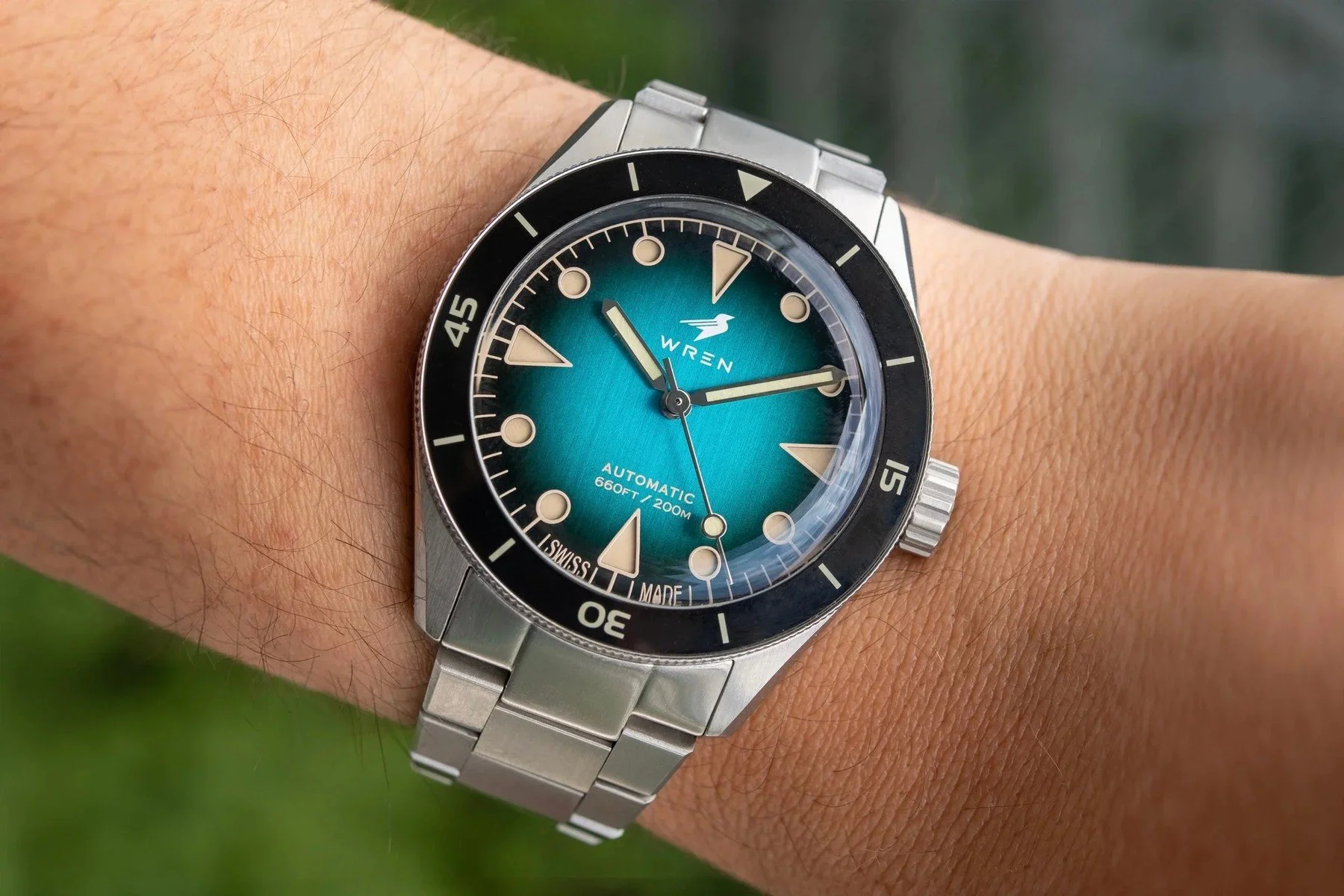
41mm, 47mm lug to lug, 13.3mm thick, Sellita SW200, 200m, from $1,195 USD
The Diver One is where Wren started and it is still the cheapest way in. It is a 41mm steel diver with a ceramic bezel, a double domed box sapphire, a screw-down crown and 200 meters of water resistance, and the thing that makes it a Wren is the dial. Every Diver One has a sandwich dial with a gradient, aqua on the original, then Sand, Snow and the orange-to-black Magma, with the hour markers cut through the top plate so the lume sits beneath it instead of on top. It ships on a flat-link bracelet with the clear coating, and a rubber strap comes in the box. It is the watch I would put up against anything in our guide to the best dive watches under $1,000.
The original Aqua, Sand and Snow were $965 USD, the Magma is $1,075 USD, and the two special editions, the Obsidian and the Abyss, are $1,195 USD. Most of them are sold out at any given moment, which is the honest state of the brand right now, so if one is in stock it is worth not waiting.
The Black One: Diver One Abyss
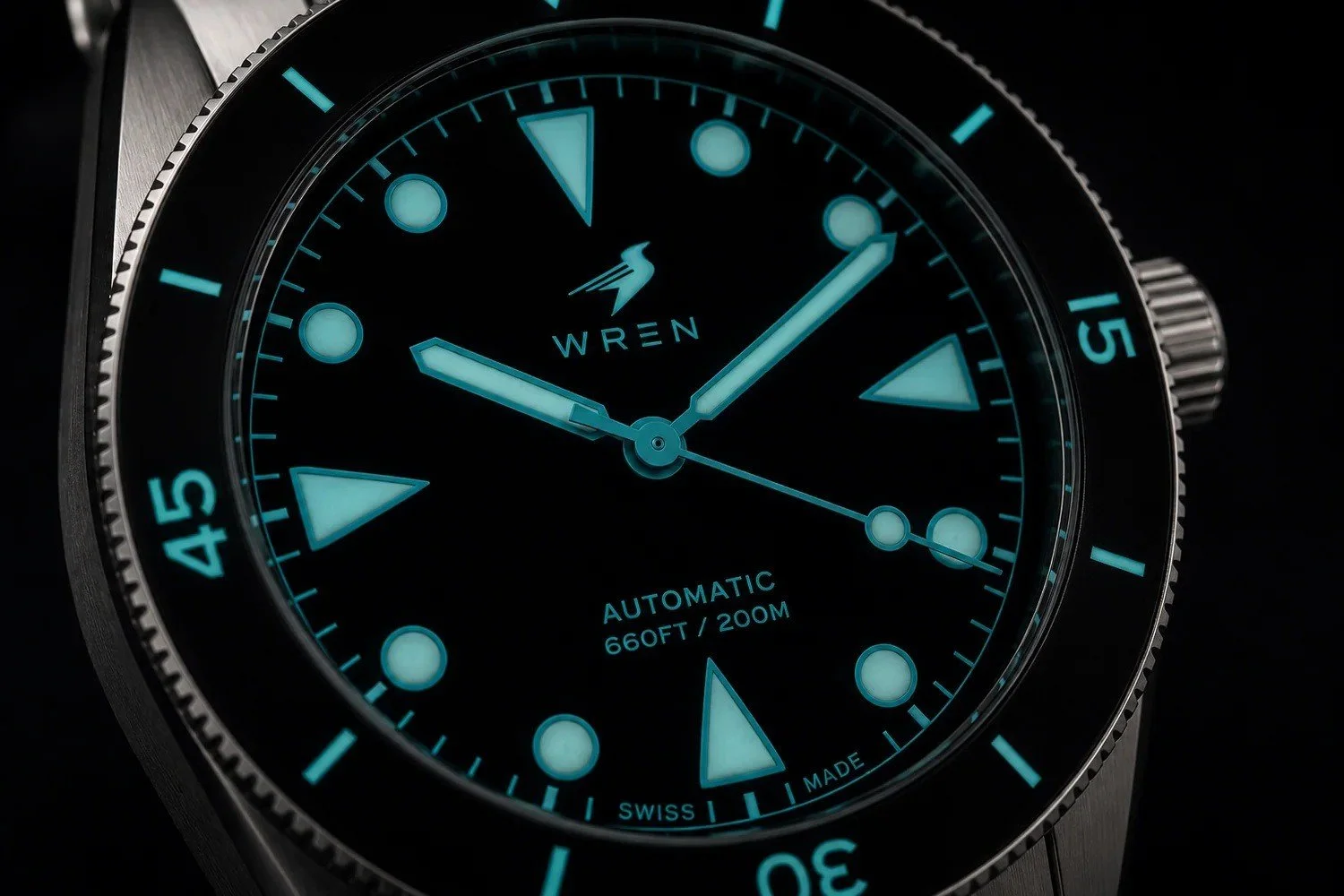
41mm, 47mm lug to lug, 13.3mm thick, Sellita SW200, 200m, $1,195 USD
People asked for a black Wren for two years and I did not want to make an ordinary one. The Abyss, which launched in August 2026, has a dial finished in Musou Black, the Japanese coating that absorbs about 99.4 percent of the light that hits it. On a normal black dial you can see the surface. On this one you cannot, so the hour markers, hands, logo and bezel scale, all of them in aqua, look like they are floating over nothing. Because the dial is a sandwich, the markers are cut through the plate rather than sitting on it, which is what keeps it legible when most ultra-black dials have to give up markers entirely.
Two things to be clear about. The bezel is normal black ceramic, not Musou Black, and Vantablack is darker than this, at around 99.965 percent. The watches that use Vantablack cost north of $70,000 USD, so I have made my peace with 99.4. The case is the same clear-coated steel as every other Diver One and the first 100 are individually numbered.
The Light One: Diver One Titanium
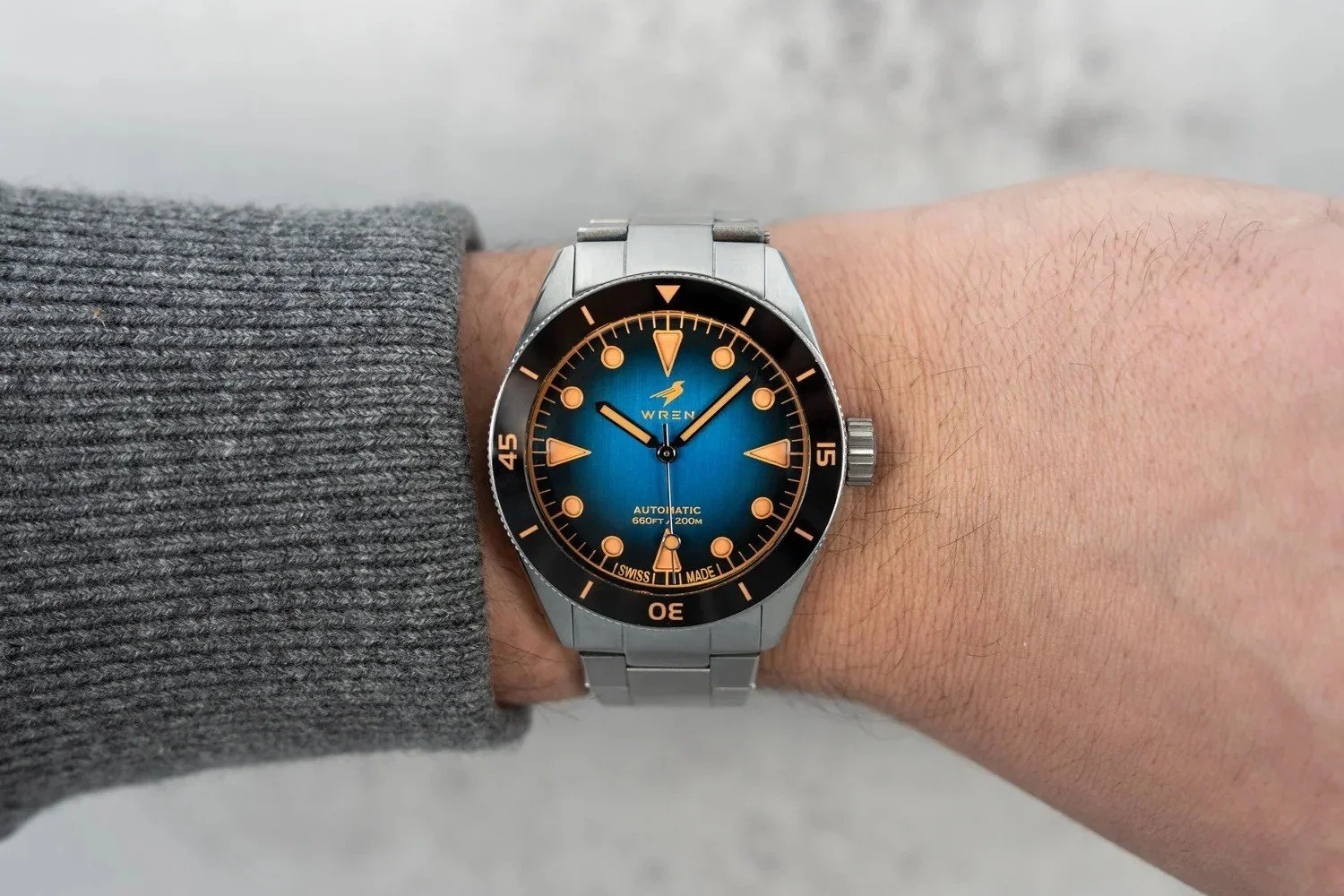
41mm, 47mm lug to lug, 12.4mm thick, ETA 2824, 200m, $1,395 USD
The Diver One Titanium is the same watch as the steel Diver One in every dimension but one. The case is grade 5 titanium, which we chose over grade 2 because grade 2 has a yellow cast and grade 5 looks almost exactly like steel, and we used the change of material to shave nearly a millimeter off the thickness, from 13.3mm to 12.4mm. It is noticeably lighter on the wrist, it runs an ETA 2824 rather than the Sellita, and it has the same clear coating and the same fully lumed bezel scale as the steel version.
It launched in late 2025 with the Dusk, a sunset gradient with orange lume, and the Snow, and it has quietly become one of the fastest-selling things we make. If you have been looking at the steel Diver One and wondering whether the extra $200 USD is worth it, it is the thickness and the weight you are paying for, and if either of those matters to you this is the one.
The Small One: Diver 38
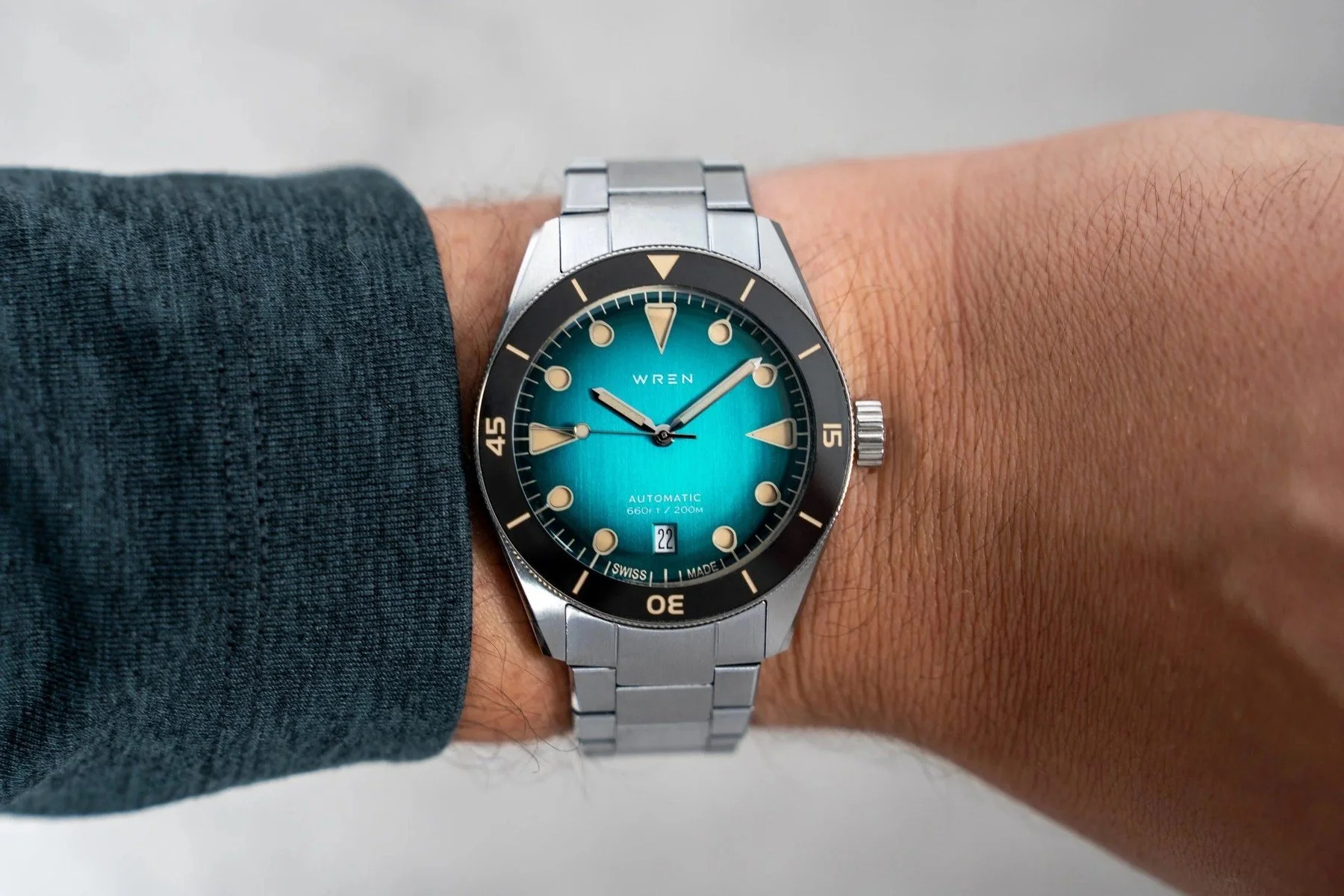
38mm, 10.7mm thick, Sellita SW300-1, 56-hour power reserve, 200m, $1,595 USD
The Diver 38 is the watch I am proudest of as a piece of engineering. It is a 200-meter diver with a ceramic bezel that is 10.7mm thick including the box sapphire, and under 10mm without it, which puts it in the company of thin dive watches that cost several times as much. Getting there meant small decisions all over the watch, down to the seconds hand, whose tip is curved downward to follow the inside of the crystal because the hand sits above the bezel and there was no room to spare. It has a display caseback with a skeletonized rotor shaped like a wren, a bracelet with a micro-adjust clasp, and it is the only Wren offered with or without a date.
The dials are where it has had the most fun: the Aqua and Seafoam gradients, the Crimson that was a Time+Tide exclusive, and the Mad, an all-white watch with a sapphire bezel that lumes across its entire surface. Hodinkee went hands-on with it in 2025, which is not something I expected to write about my own watch. At $1,595 USD it is the most expensive diver we make, and I will say plainly that the jump from the Diver One's price got pushback from some readers. The thinness is what you are paying for.
The New One: Vessel
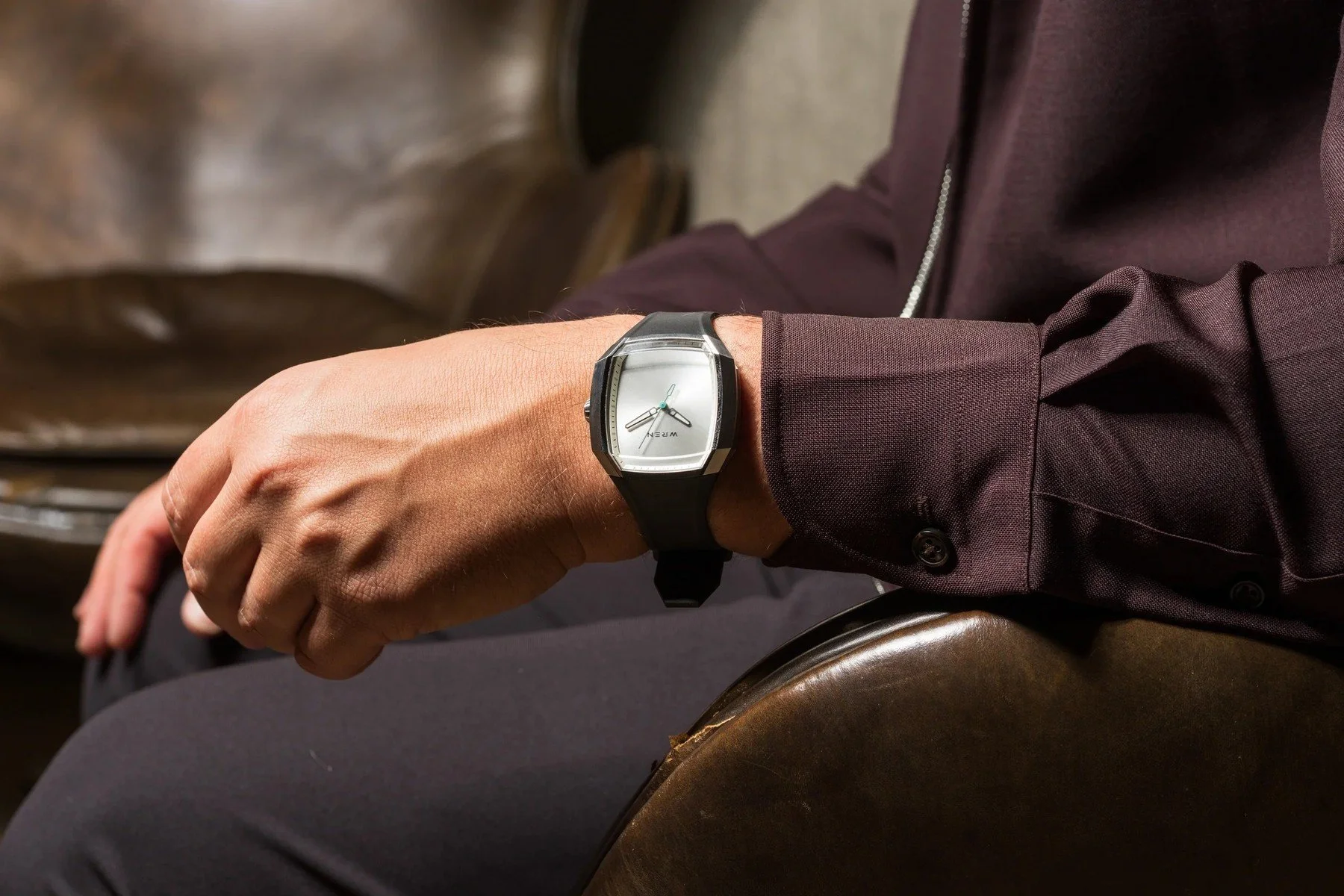
39mm x 39mm, 10.6mm thick, 904L steel, Sellita SW300-1, 70m, $2,900 USD or $3,400 USD
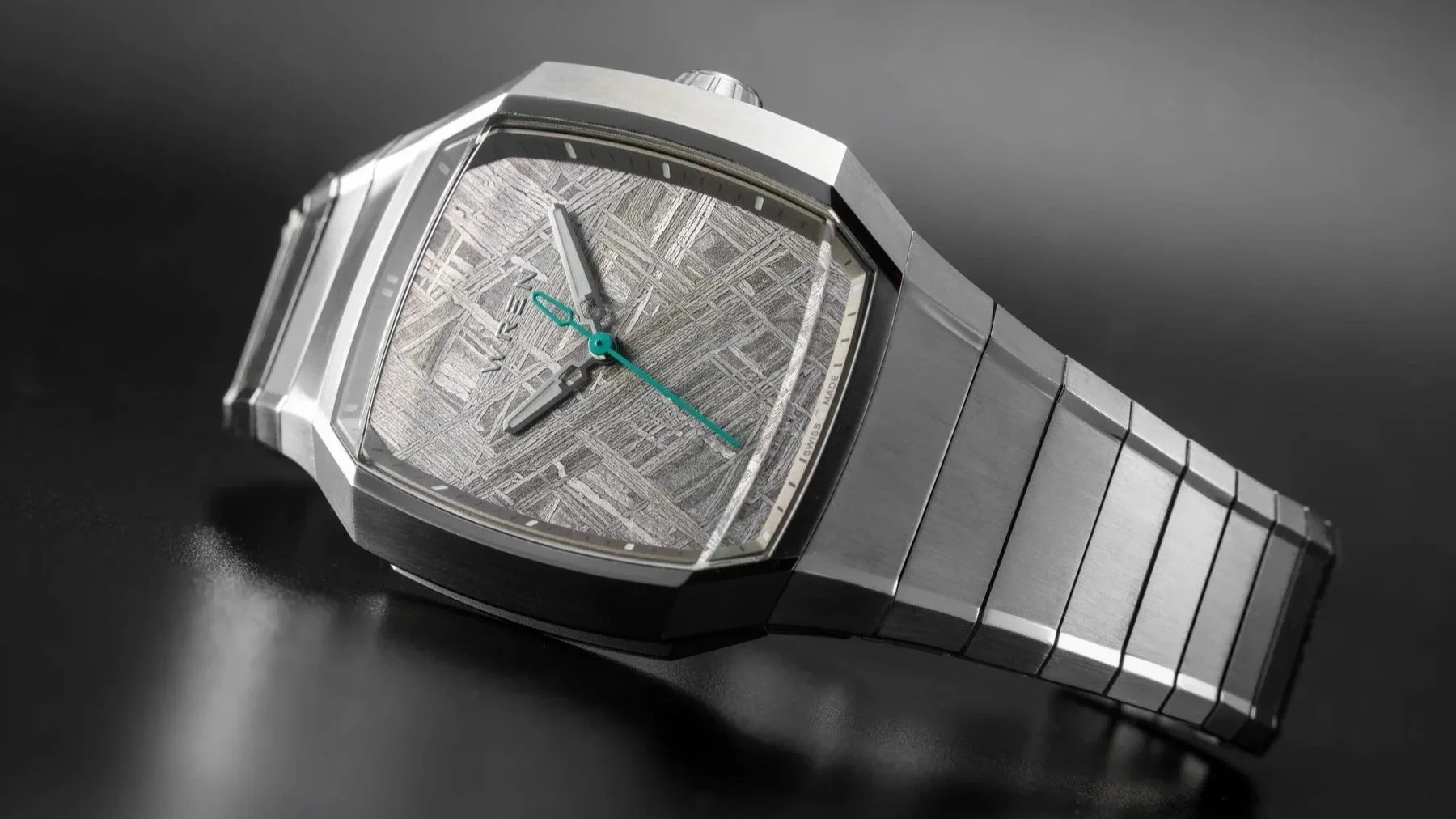
The Vessel is the first Wren that is not a dive watch, and it is the watch I spent two years on with Max Resnick. The brief was an integrated-bracelet sports watch that did not look like another 1970s Genta homage, something that felt designed in 2075 rather than 1975, with a faceted sapphire crystal as the reason the rest of the watch existed. The case is a cushion built around a square, 39mm across and 10.6mm thick in 904L steel, with a bracelet that uses a quick-release system we developed from scratch and micro-adjustment built into the links rather than the clasp.
The crystal is the whole story. It is faceted and curved on top, and then cut again underneath as a curved faceted negative of the top, so the dial reads true with no distortion where the facets meet. As far as I have been able to find, nobody had made a sapphire crystal with that geometry before, and the first batch of prototypes came back with a 95 percent failure rate. The crystal costs more to produce than the movement, which is backwards from how watches at this price usually work. It launched in October 2026 in two versions, a steel sunray dial at $2,900 USD and a meteorite dial at $3,400 USD, 150 of each, both with an aqua seconds hand and rotor that trace back to the Diver One Aqua. The meteorite sold out first. Deliveries are scheduled for early 2027.
The things to know before you buy: it is 70 meters water resistant with a push-pull crown, which is fine for a sports watch and not fine for diving, and because it is the first run of a new case there is no track record yet. I think it is the best thing we have made. I would also understand waiting for the first owner reviews.
The Collaborations: Magma, Obsidian and Crimson
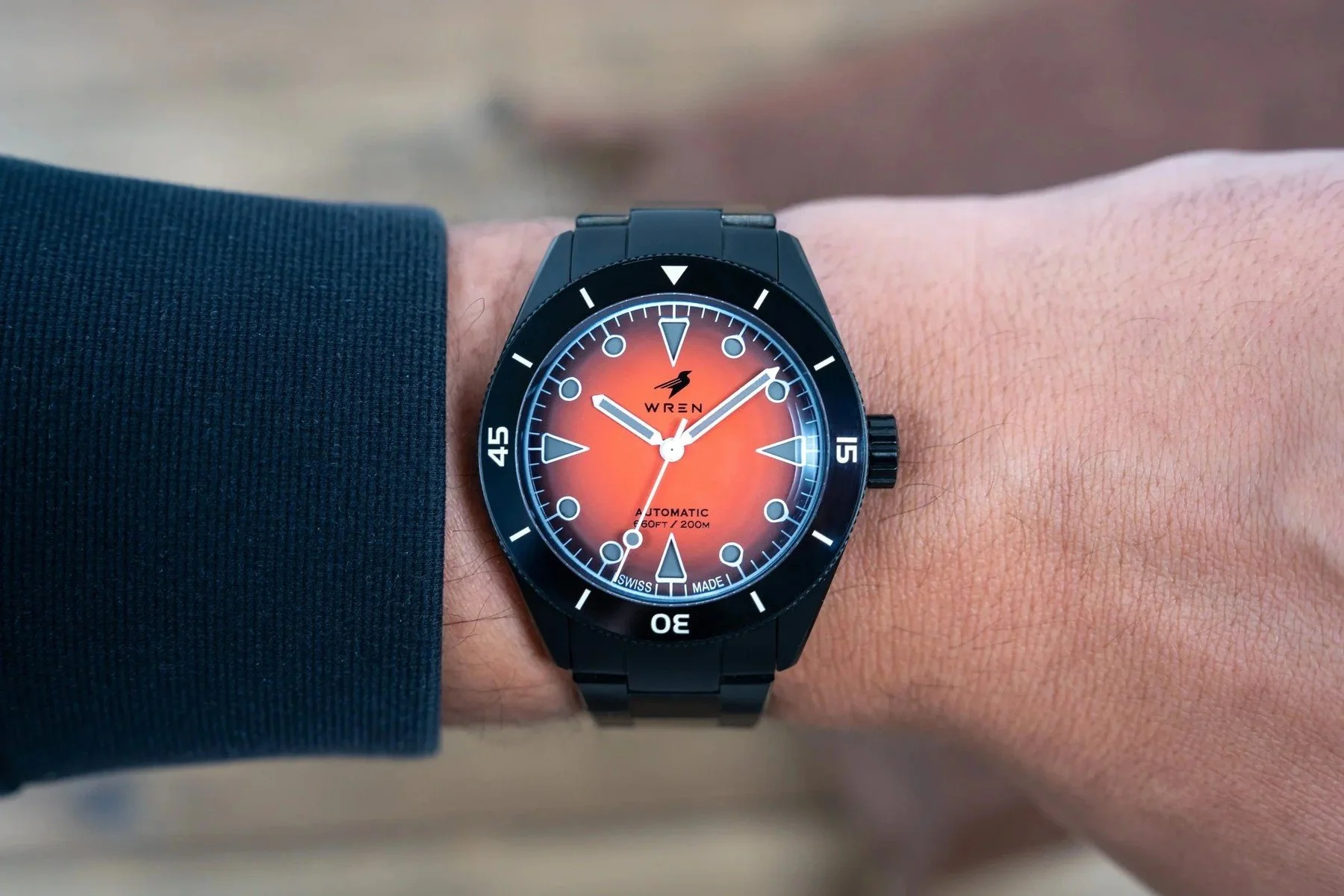
Three Wrens were made with other people. The Diver One Magma, the orange-to-black gradient, and the Diver One Obsidian were both done with Ben Cook of Ben's Watches, who is as close as Wren has to a brand ambassador. The Obsidian is the one outlier in the whole lineup: an orange dial in a black DLC case with a matching orange rubber strap, 100 pieces at $1,195 USD, and it sold out online in about an hour in July 2026, with a further 20 pieces going through Time+Tide. The Diver 38 Crimson was a Time+Tide exclusive, a deep red gradient on the 38mm case, and it sold out there in three days.
I mention these because they are the Wrens you are most likely to see on the secondary market at a premium, and because the pattern will continue. The collaborations have been the fastest sellouts we have had, and there will be more of them.
Are Wren Watches Good?
I am the wrong person to ask, so let me give you the case against and let the rest of the article make the case for. The prices have climbed. The first Diver One was $965 USD and the Diver 38 is $1,595 USD, and some long-time readers have told me the 38 priced them out. The watches are almost always sold out, which is nice for us and annoying for you, and a lot of what we sell is preorder with a wait of months. Not every release has worked: the Diver One Sand was our slowest seller and we cut its run in half and turned the leftover cases into the first Magmas, and the Diver 38 Mad took the better part of a year to sell 50 pieces. The Vessel is 70 meters and push-pull, which will bother the people who want one watch for everything. And Wren does not have a design signature you can spot across a room the way a Baltic or an Underd0g does, which is something the Vessel is meant to start fixing.
What I will claim without hedging is the build. Swiss movements, Swiss assembly, box sapphire crystals, ceramic bezels with the full scale lumed, sandwich dials on every diver, and a hardness coating that nobody else at this price offers on every single watch. Hodinkee, Gear Patrol, Worn & Wound, Time+Tide and Revolution have all covered the watches on their merits, and the two-year warranty is handled from New York with shipping paid both ways on a valid claim. Return policy is 14 days, preorders are refundable until the watch ships, and we recommend service every five to seven years.
How Much Do Wren Watches Cost?
As of November 2026: the steel Diver One is $1,195 USD (Obsidian and the Abyss). The Diver One Titanium is $1,395 USD. The Diver 38 is $1,595 USD in every dial, with or without a date. The Vessel is $2,900 USD with the steel sunray dial and $3,400 USD with meteorite. Rubber straps for the divers are $95 USD and the Vessel strap is $195 USD. Prices are in US dollars, there are no discounts and there never will be, and the number you see is the number.
You can buy direct at wrenwatches.com, which is where the full lineup, the waitlists and the preorders live, or through Time+Tide in the US and the UK, which carries a rotating selection and occasionally an exclusive. Because every batch is 100 per dial, the practical advice is to join the waitlist for the one you want. Previous customers get a few days of early access before each release opens, and that early window has been where most of the recent sellouts happened.
Which Wren Should You Buy?
If I had to own one, it would be the Diver 38, because it is the watch that best shows what the brand is trying to do: a real 200-meter diver at 10.7mm with a full-lume bezel and a Swiss movement, in a size that most of the industry still refuses to make properly. If you have a larger wrist or you want the most watch for the money, the Diver One Titanium at $1,395 USD is the sweet spot, lighter and thinner than the steel version for not much more. If you want the one people will ask about, it is the Abyss. And if you want to see where Wren goes next, the Vessel is that watch, with the caveat that it is new and you are early.
Whatever you choose, you will get a Swiss-made watch with a coating that keeps it looking new, lume that makes most watches at the price look dim, and a dial that is not the ordinary version. That was the point of starting the brand, and it still is.