
Hands-On Review of the Biver Automatique in Yellow Gold and Yellow Gold & Carbon Fiber
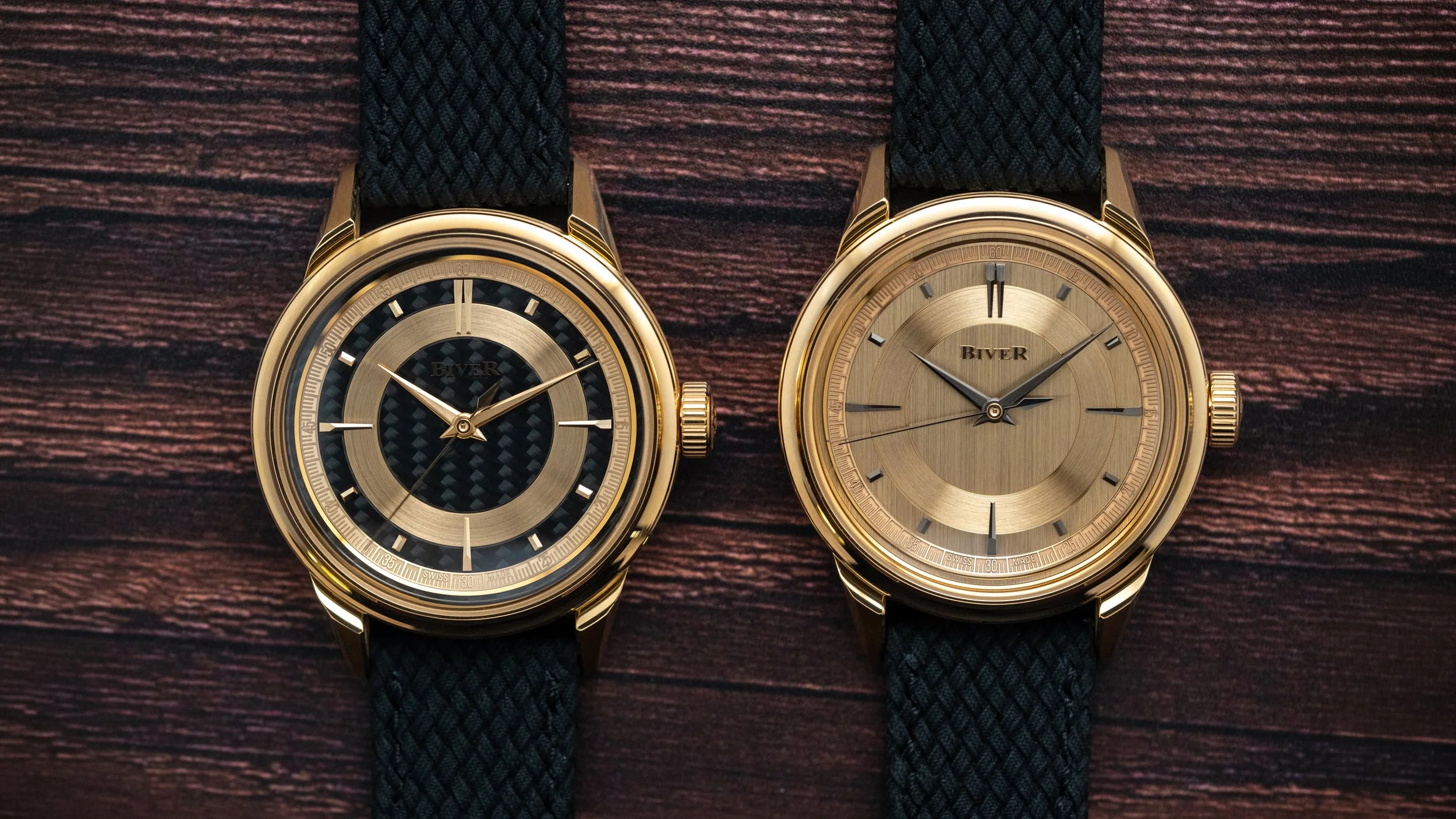
There’s something fitting about Jean-Claude Biver finally putting his own name on a simple three-hand watch. For decades he’s been the force behind other brands, reviving Blancpain, reshaping Omega, redefining Hublot, and steering TAG Heuer’s image. Now, working alongside his son Pierre, he’s turned that energy inward. The Biver Automatique feels like a new chapter for him: a watch about restraint, refinement, and almost obsessive attention to detail.
In yellow gold, it’s also the most classical expression of that idea.
I spent time with two versions: the Automatique Yellow Gold, which reads as a warm, traditional dress watch, and the Automatique Yellow Gold Carbon Edition, which takes the same blueprint and pushes it into something moodier and more experimental. Seen together, they capture what “Biver” now means on a dial: heritage and innovation sitting side by side.
Design and light
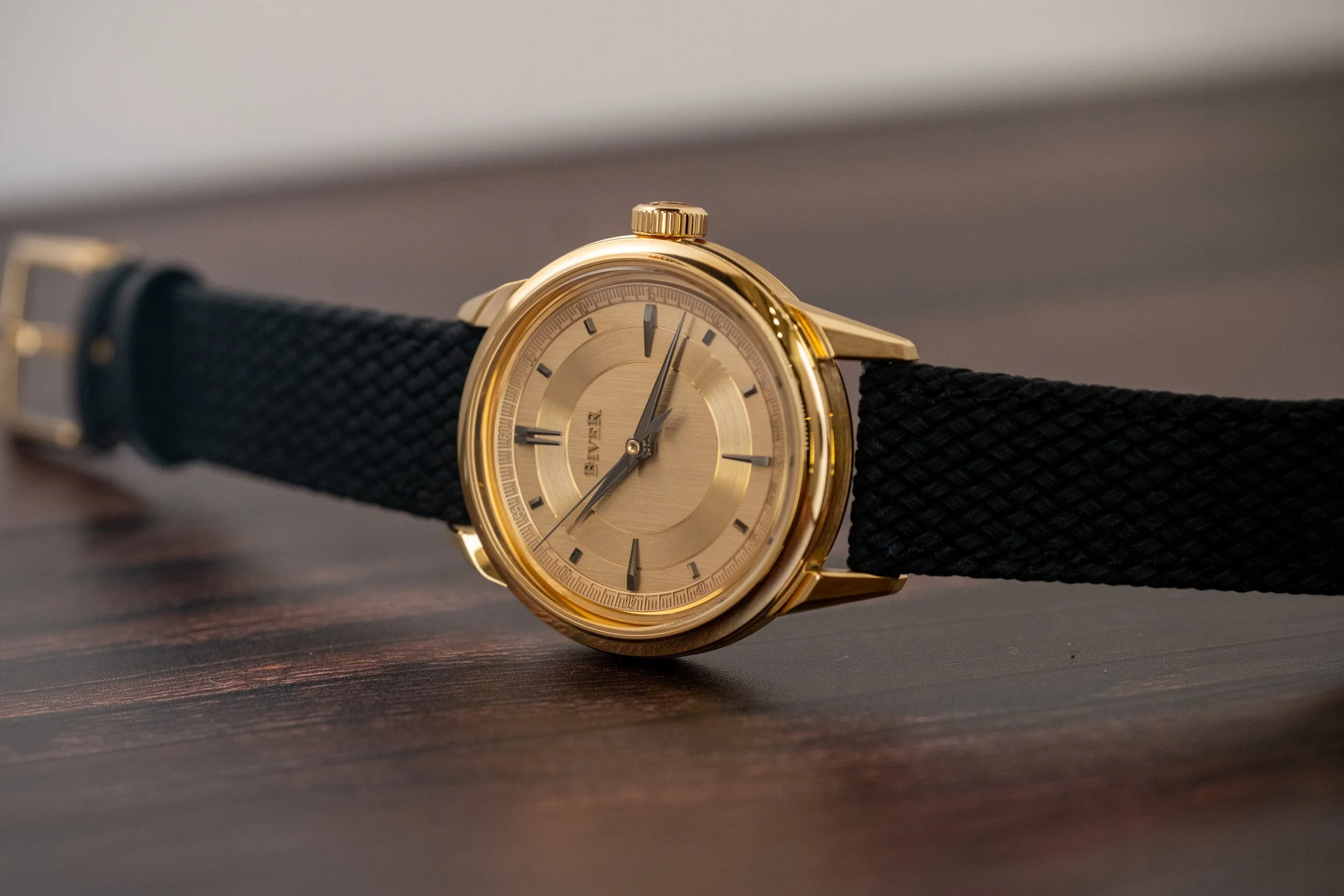
On paper, the Automatique Yellow Gold sounds straightforward: a 39 mm case in 18k 3N yellow gold, just 10 mm thick, with long, faceted lugs that taper gracefully into the strap. On the wrist, it’s much more nuanced.
The dial is solid gold as well, cut from a single piece and finished with alternating vertical and circular brushing that creates a subtle two-tone effect. The outer and inner rings are vertically brushed, while the center is finished in concentric graining, so each surface reacts to light differently and gives real depth to what is technically a monochrome dial. Instead of a printed minutes track, the watch uses a laser-engraved chemin de fer in relief, with raised gold markings that throw tiny shadows as you move your wrist. The faceted, hand-finished indexes and hands are treated in anthracite, softening the contrast and keeping the warmth of the gold front and center.
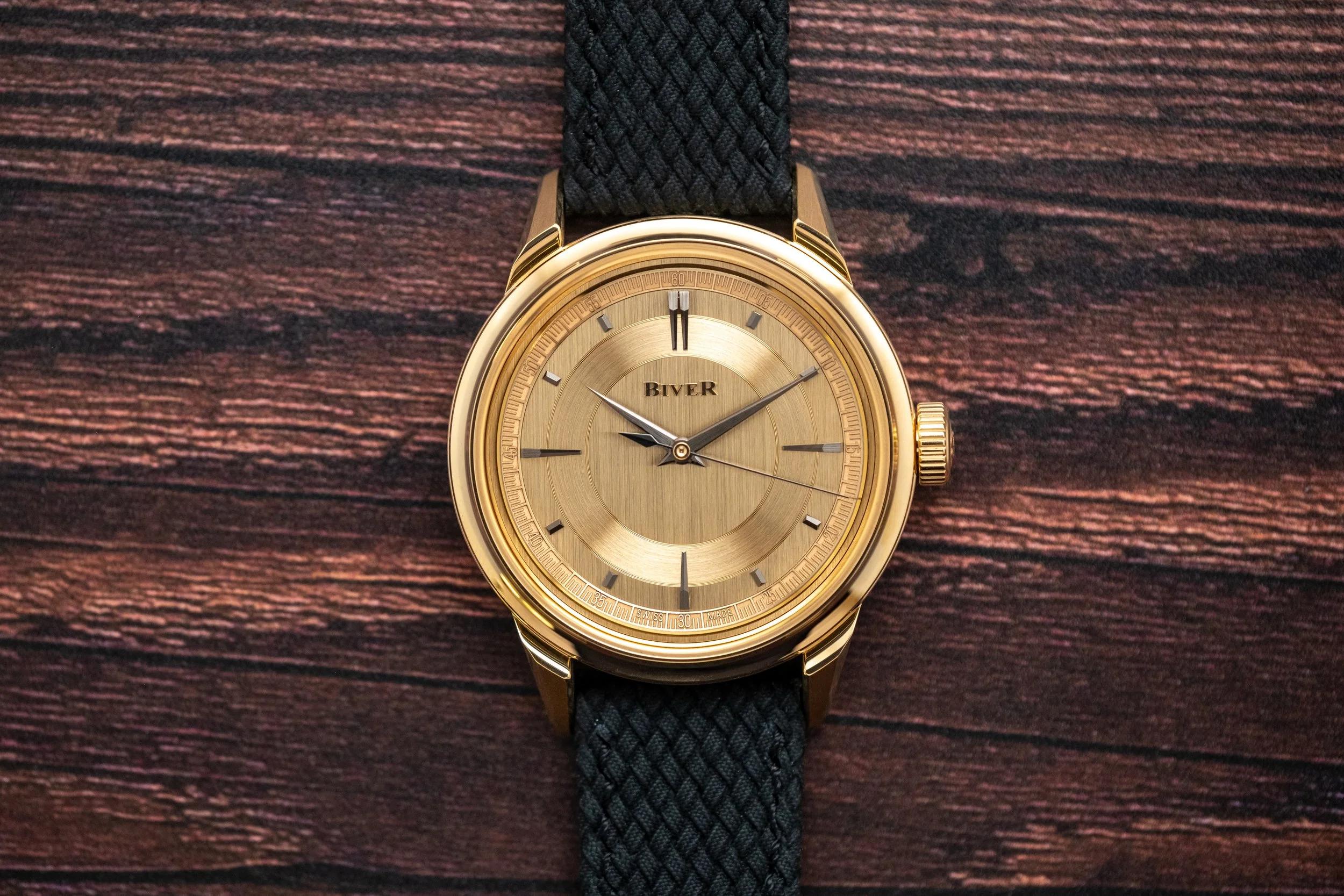
Nothing about it feels like a vintage pastiche. The proportions and tones nod to mid-century dress watches, but the execution is sharply modern.
The Carbon Edition
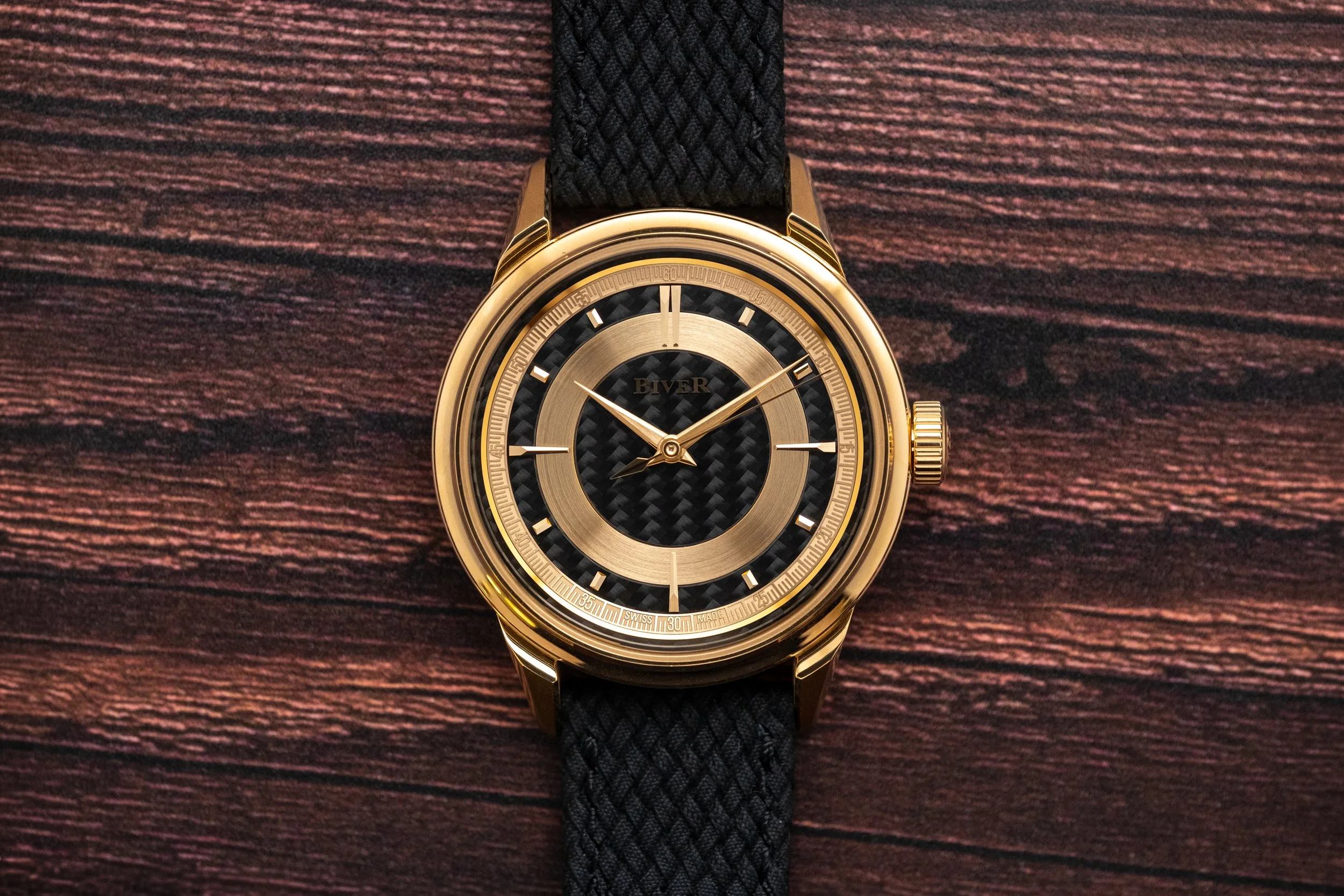
The Automatique Yellow Gold & Carbon Edition takes that same architecture and changes the mood entirely. The 39 mm yellow gold case and 80m water resistance remain, an unexpectedly robust spec for a watch that visually sits in dress territory. The real shift is on the dial.
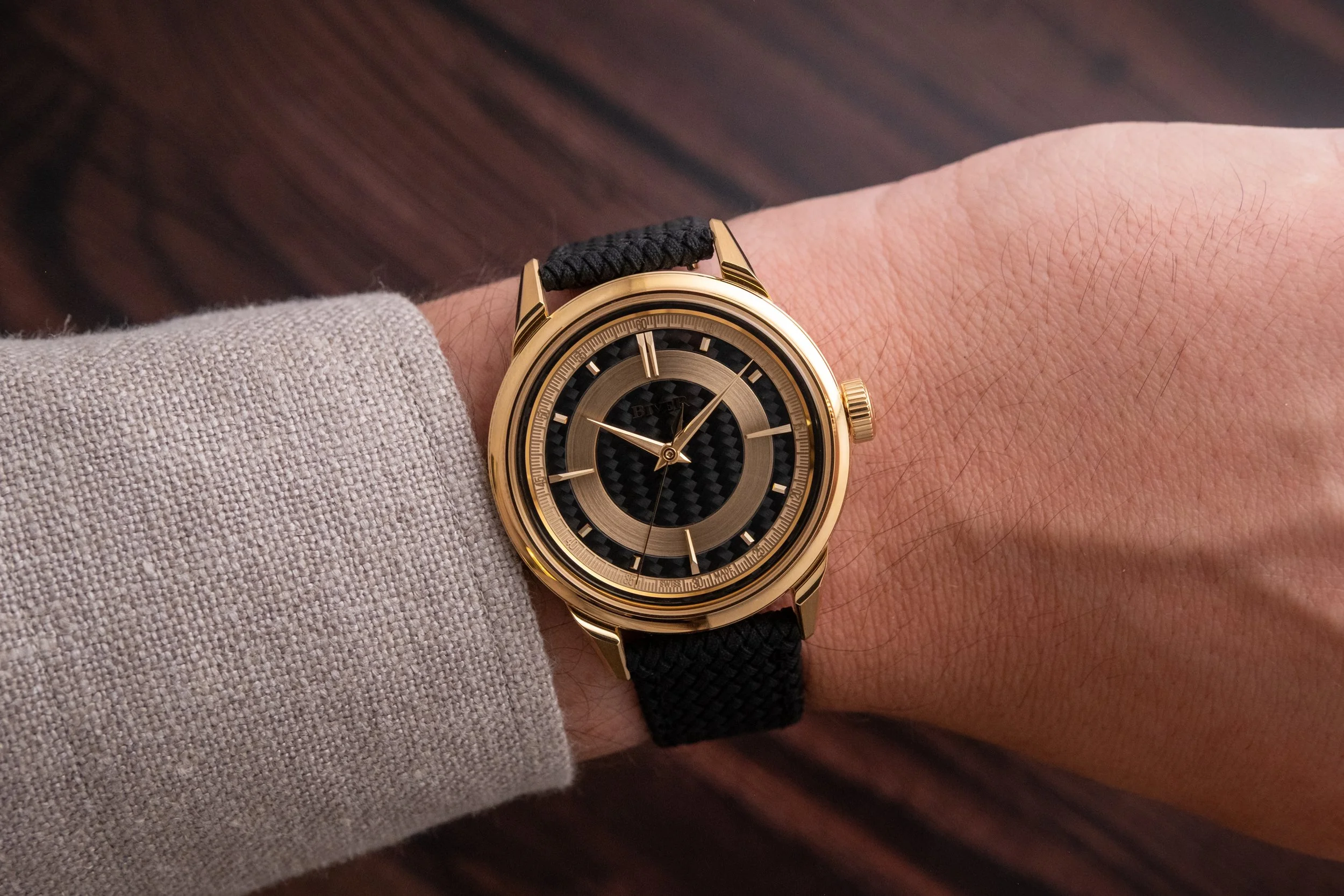
Here, the brushed gold dial gives way to woven carbon fiber, replacing soft radiating textures with a tight pattern that flips between glossy and matte depending on the angle. The gold minutes track and brushed mid-ring are still there, but the carbon injects an industrial, almost aggressive character. The contrast, warm gold against the cool, technical weave, is jarring at first and then strangely compelling once your eyes adjust.
This version also comes with a braided strap, altogether making it feel genuinely casual in intent . It’s easy to imagine it with a T-shirt in a humid city as much as with tailoring, which isn’t something you can say about many high-end yellow gold three-handers.
Movement and finishing
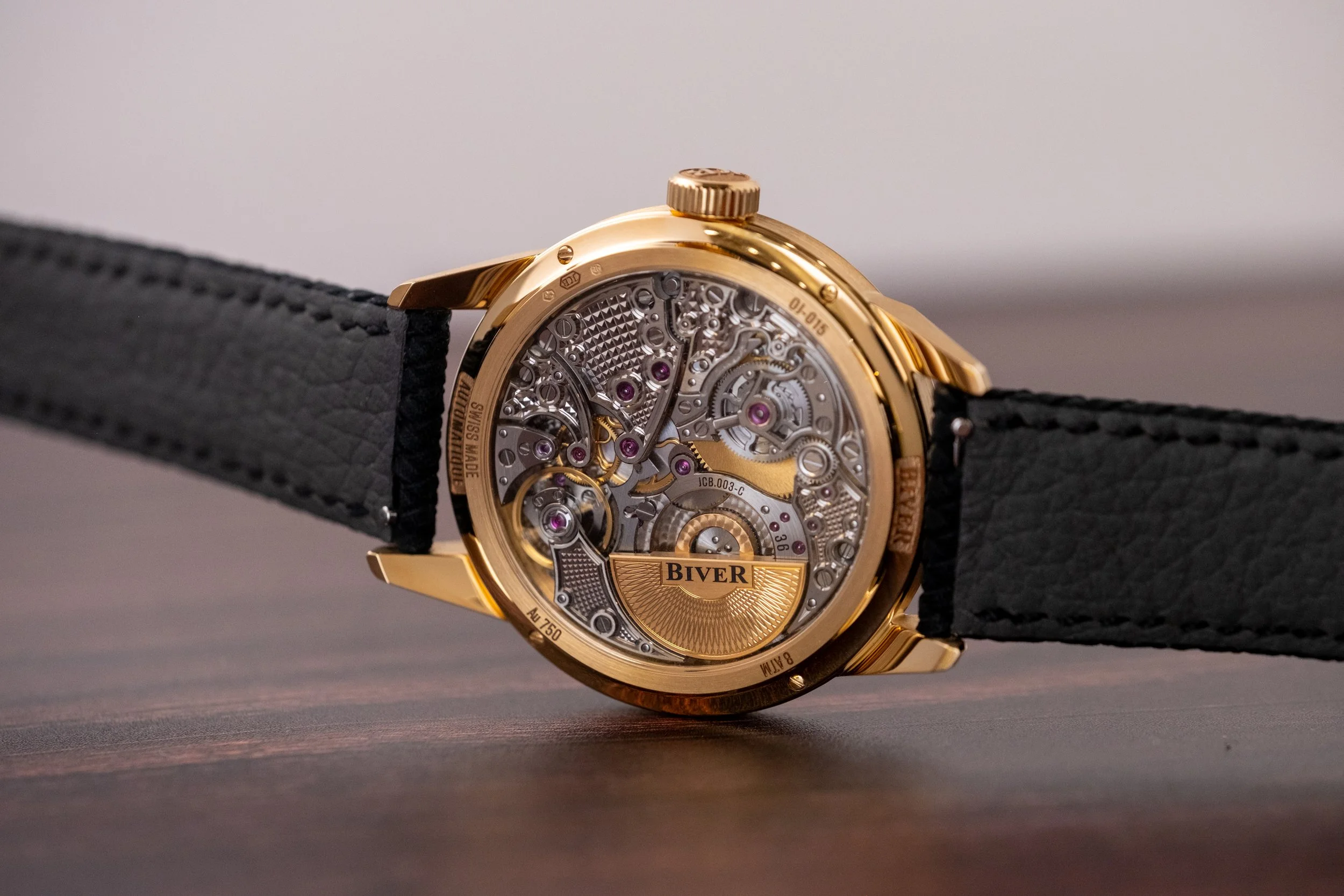
Flip either watch over and the focus shifts immediately to the movement. Both are powered by the Caliber JCB.003-C, an automatic micro-rotor caliber developed with Dubois Dépraz specifically for the Automatique. It beats at 3.5 Hz, offers a 65-hour power reserve, and features a zero-reset seconds function, snapping the seconds hand back to zero when you pull the crown for precise setting.
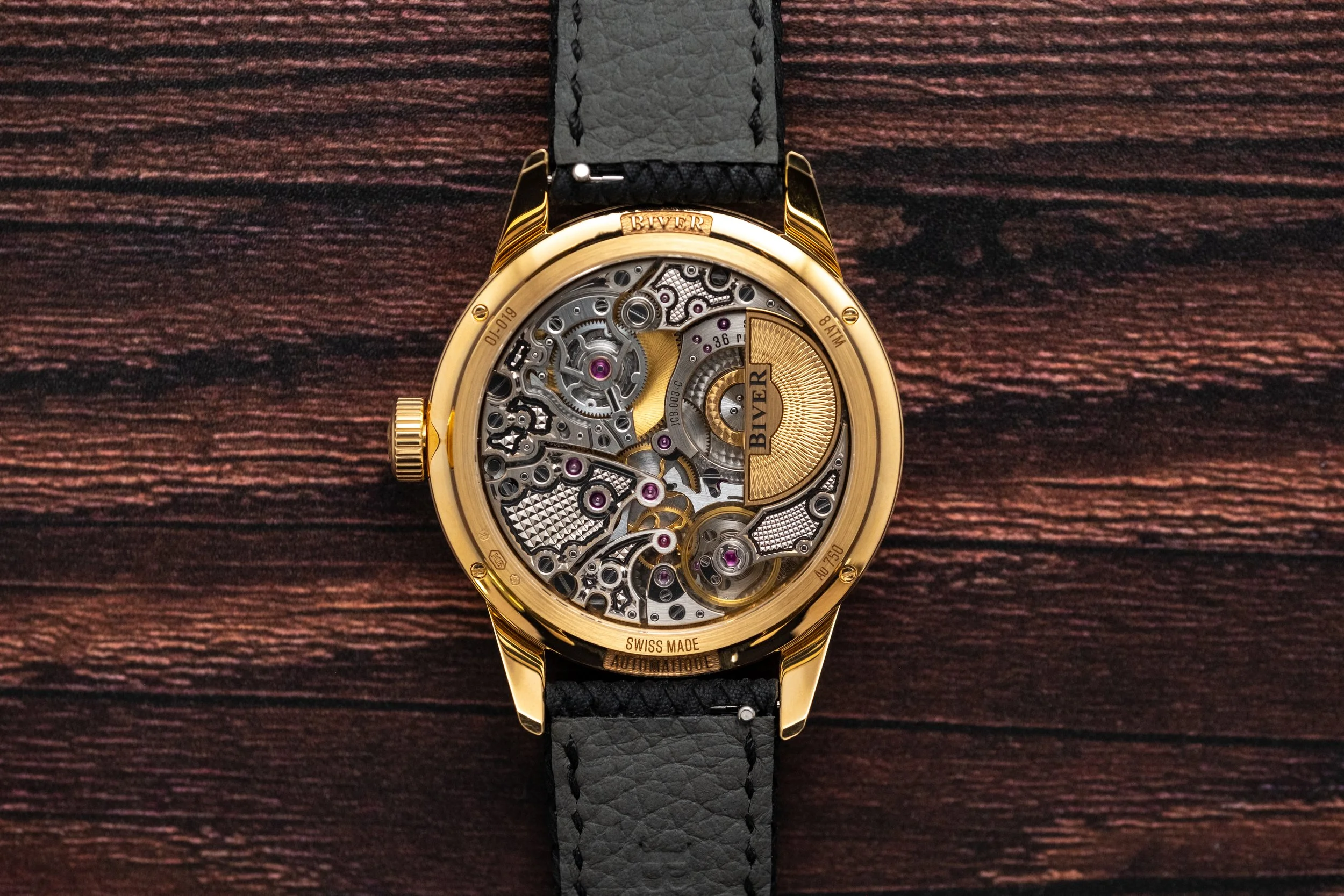
Mechanically it’s already impressive, but the real story is the finishing. The bridges are partially skeletonized with broad hand-beveled anglage, the main surfaces decorated with Clous de Paris-style guilloché, and the 22k gold micro-rotor given its own radiating pattern. Steel parts are black polished, jewel sinks are mirror-finished, and even the wheels of the going train have shaped arms with chamfered edges. It’s the kind of finishing that feels almost excessive for a time-only watch, and that’s precisely what makes it compelling in this context.
There’s a nice bit of tension here: Biver made his name scaling big brands and big marketing, not as a watchmaker at a bench. This movement reads as a direct message to the independents he once shared the market with, a way of saying he can build a watch that plays at their level of craft.
Case, wearability, and character
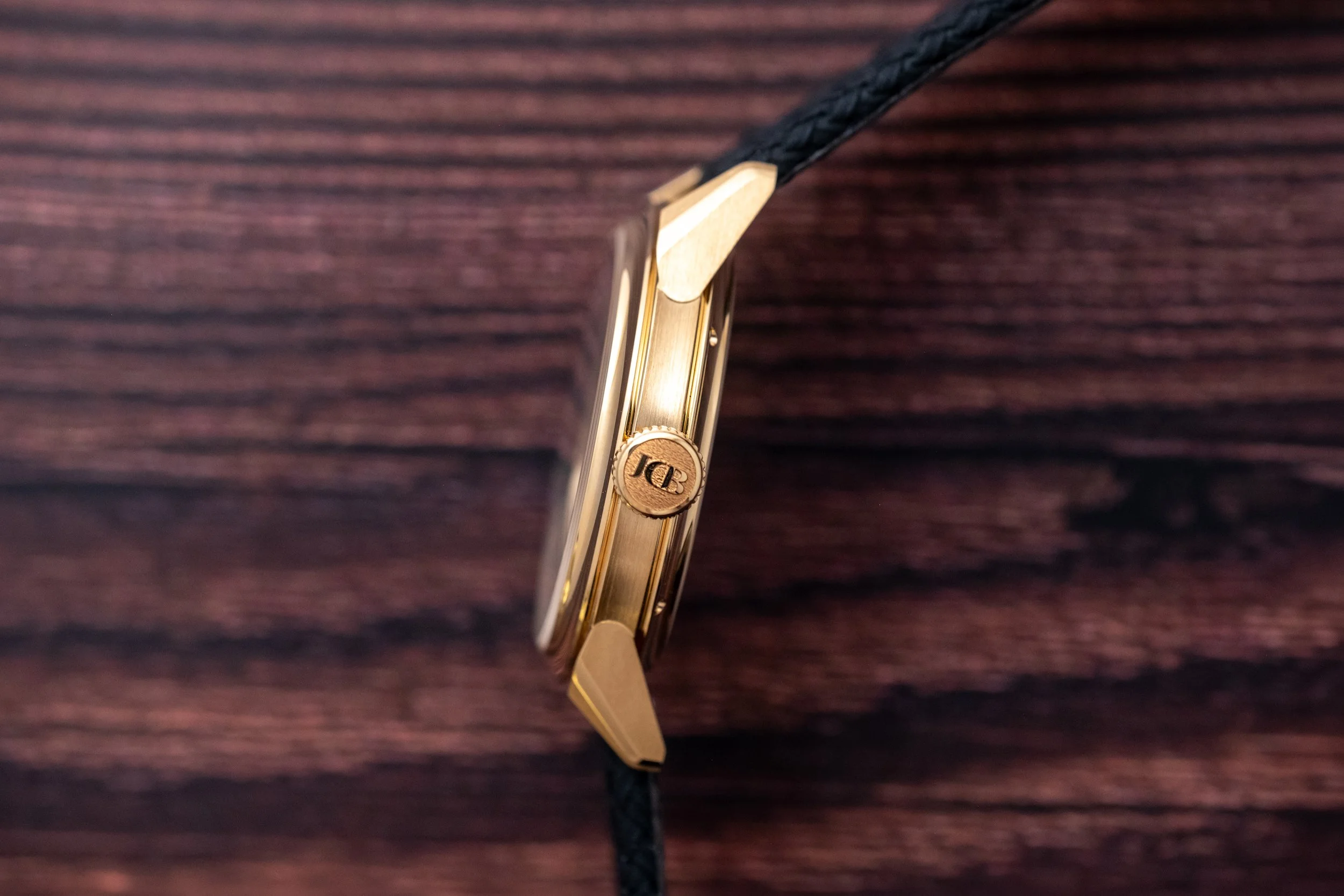
The case takes cues from one of Biver’s own collecting passions: angular, spider-lug mid-century designs, with sharply defined lugs soldered to the case and finished in alternating brushed and polished planes. The concave midcase and bezel visually thin the watch and create reflections that make the gold almost glow in good light. On the wrist, the 39 mm diameter and 10 mm thickness, combined with curved lugs, make it sit lower and more comfortably than the numbers might suggest.
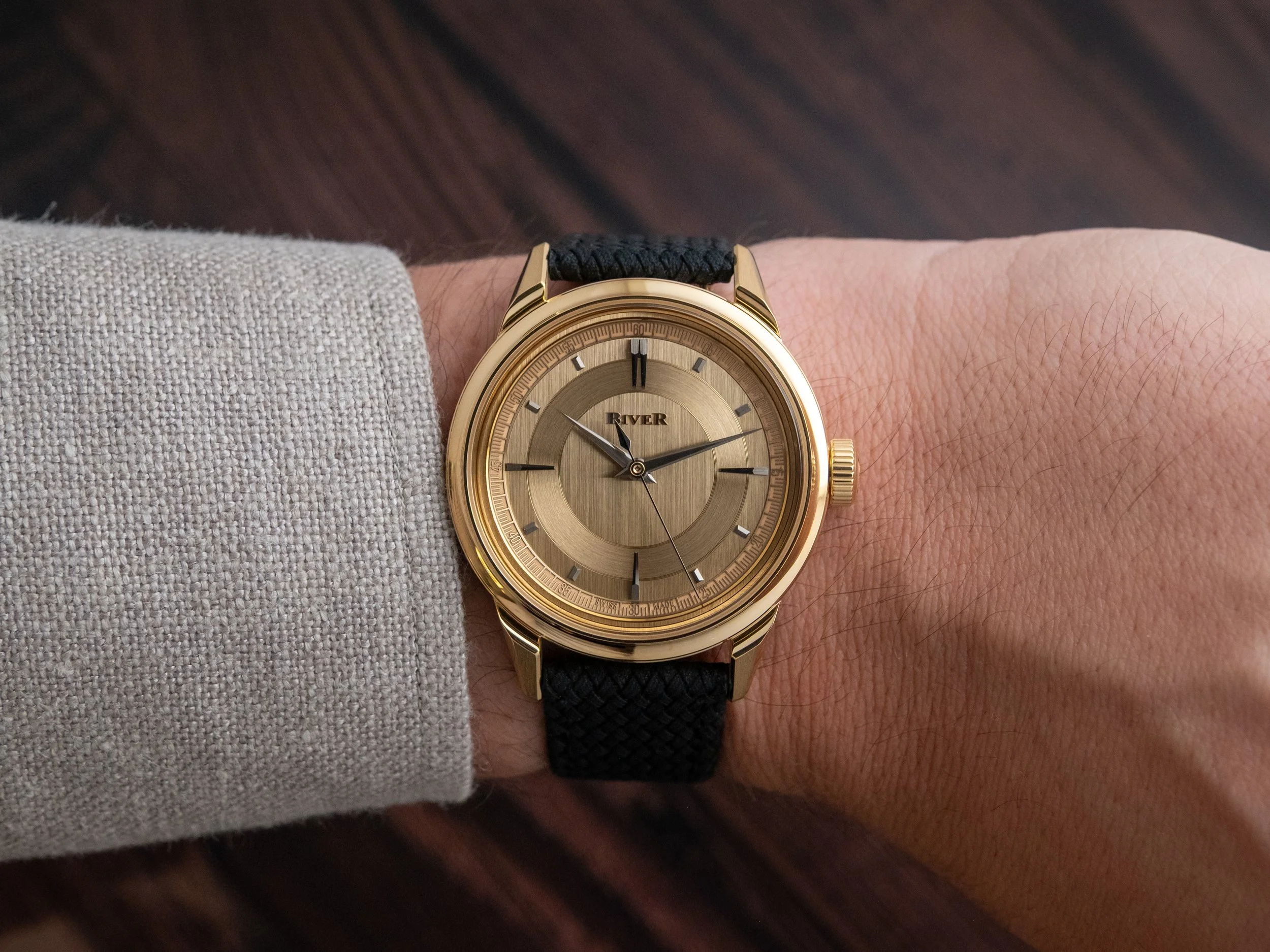
In full yellow gold, the watch feels calm and timeless, the kind of piece that could slip under a cuff now and still look right in 30 years. The Carbon Edition is the opposite: loud, graphic, and designed to be noticed, with the braided rubber strap amplifying that sportier attitude.
Price, context, and verdict
At CHF 75,000 for the yellow gold version and CHF 89,000 for the Carbon Edition, this is not a place where “value” is the main argument. You can absolutely point to other three-handers in the same bracket, from Laurent Ferrier to H. Moser, that rival or even surpass it in certain technical or aesthetic ways. What those pieces don’t have is this particular narrative, a father and son using their shared surname to build something deliberately small-scale and personal.
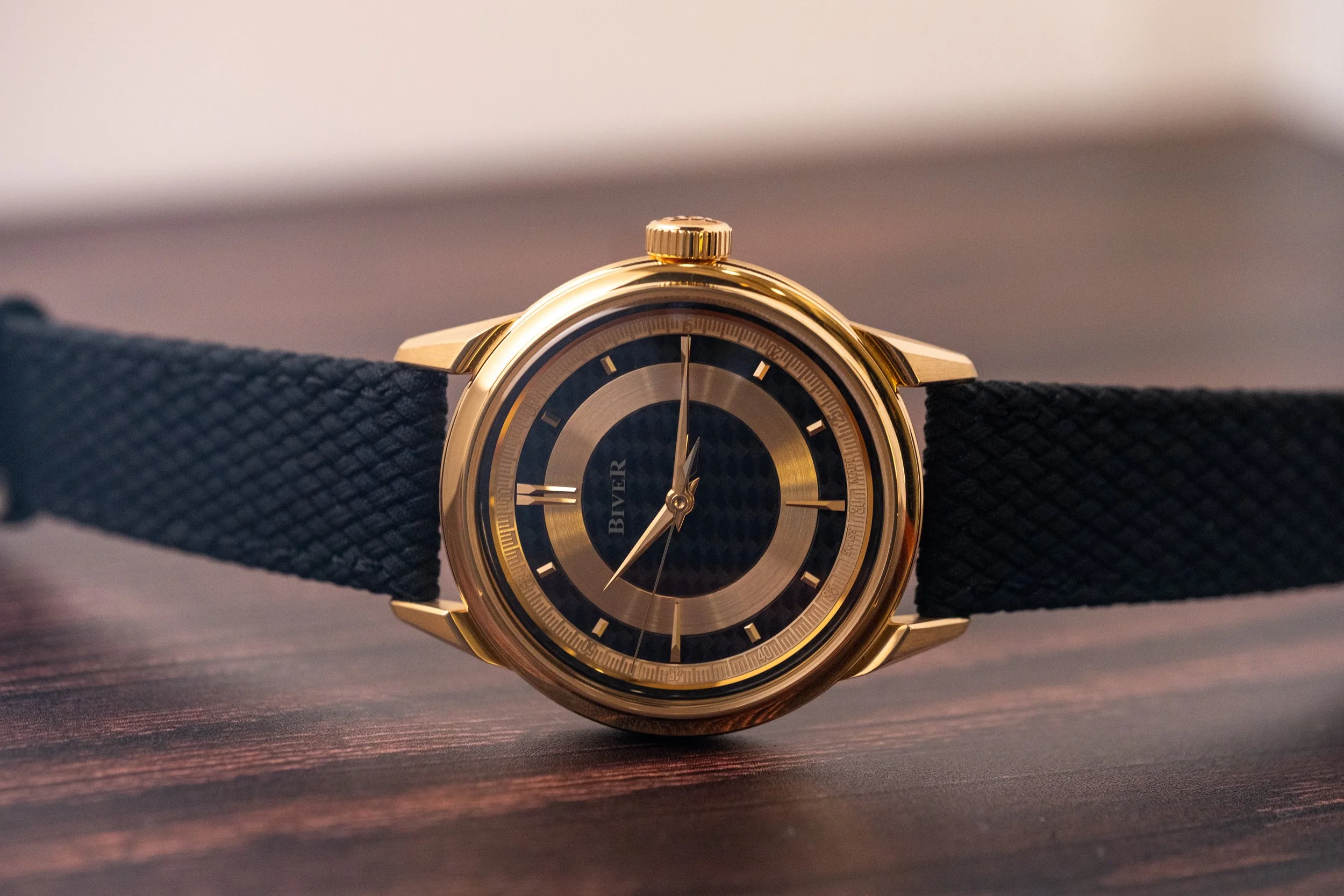
The Automatique Yellow Gold is the connoisseur’s pick, a study in light, proportion, and finishing that feels quietly self-assured. The Carbon Edition is the statement piece, intentionally polarizing and meant to stretch the design language of the line rather than sit safely in the middle. Both, though, share the same core idea: a simple watch made extravagant through craft rather than complication.
If there’s a single watch that captures Jean-Claude Biver’s career and where he is now, this might be it. Learn more about the watch here.